
A new letter is landing at suspended California hospices, and it closes a chapter that opened in the spring: the “Response to Rebuttal Statement.” We have now reviewed two of them — dated July 27 and July 30, 2026, three days apart, nearly word-for-word identical, both delivered by FedEx from Qlarant, the Western UPIC. Both say the same three things: your rebuttal was reviewed, the payment suspension continues “pending additional investigation,” and — citing 42 C.F.R. § 405.375(c) — “this determination is not appealable.” If your hospice filed a rebuttal in the April wave and has heard nothing since, this letter is likely what the silence has been building toward. Here is what both letters say, why the denial was close to automatic no matter what your rebuttal contained, the detail in the second letter that should make every hospice sharing an office suite sit up — and the playbook for the phase that actually decides your case.

CDPH Emergency Regulation Changes — Live Q&A This Wednesday at 10:00 AM Pacific
Wednesday, September 23 · 40 minutes · Hosted by Miles Pickens, Hospice Engine
Bring your questions on CDPH’s emergency hospice licensing regulations (Title 22) — nurse ratios, management qualifications, CHOW, and the licensing moratorium. Zoom link sent by email when you register. The first 3 seats each Wednesday session are free.
The Letter: Two Pages, Three Moves, No Appeal
Both letters arrived by Federal Express — one addressed to the agency’s attorney of record, one directly to the administrator — on CMS letterhead over Qlarant’s signature block. Here is the first one, dated July 30, in full, with the hospice’s identifying information removed:
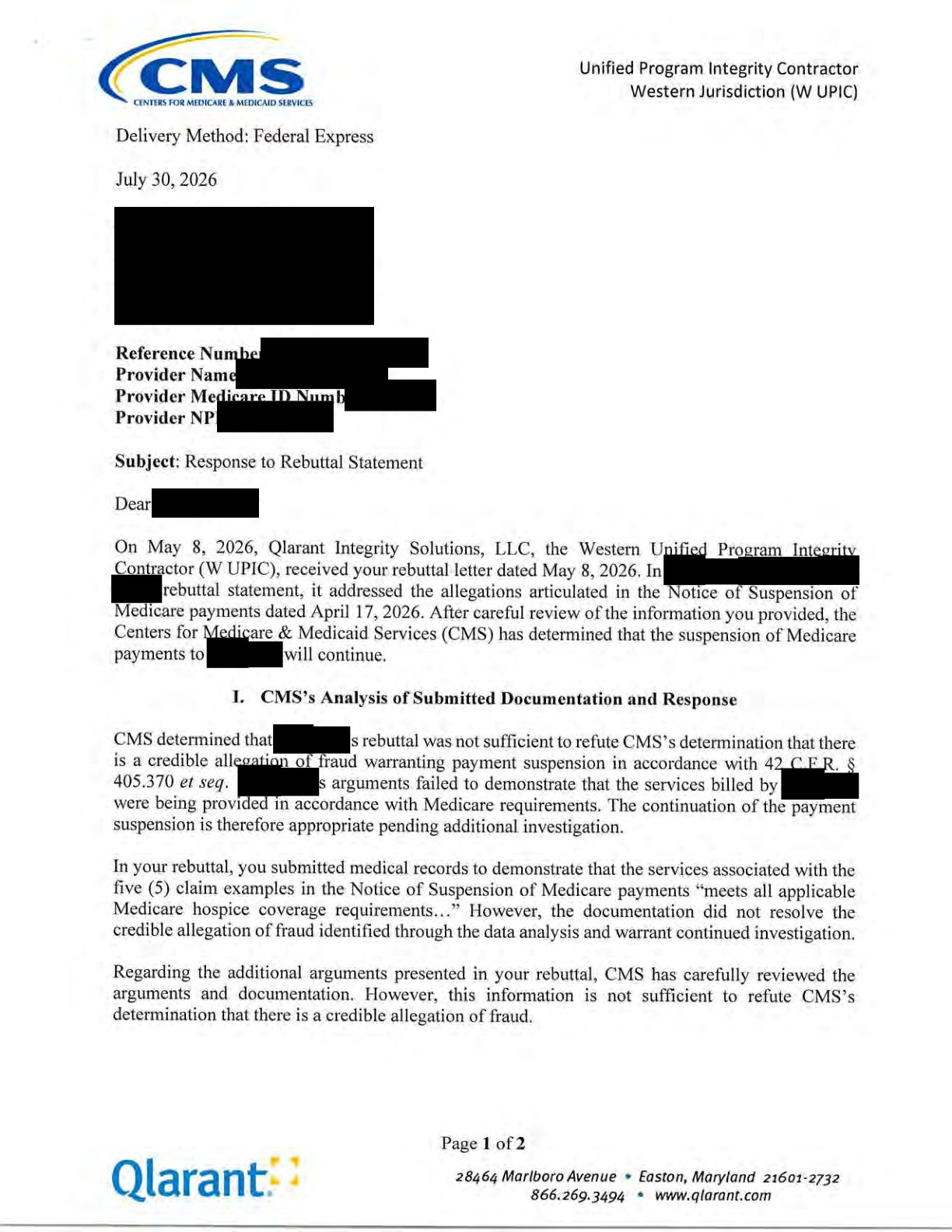
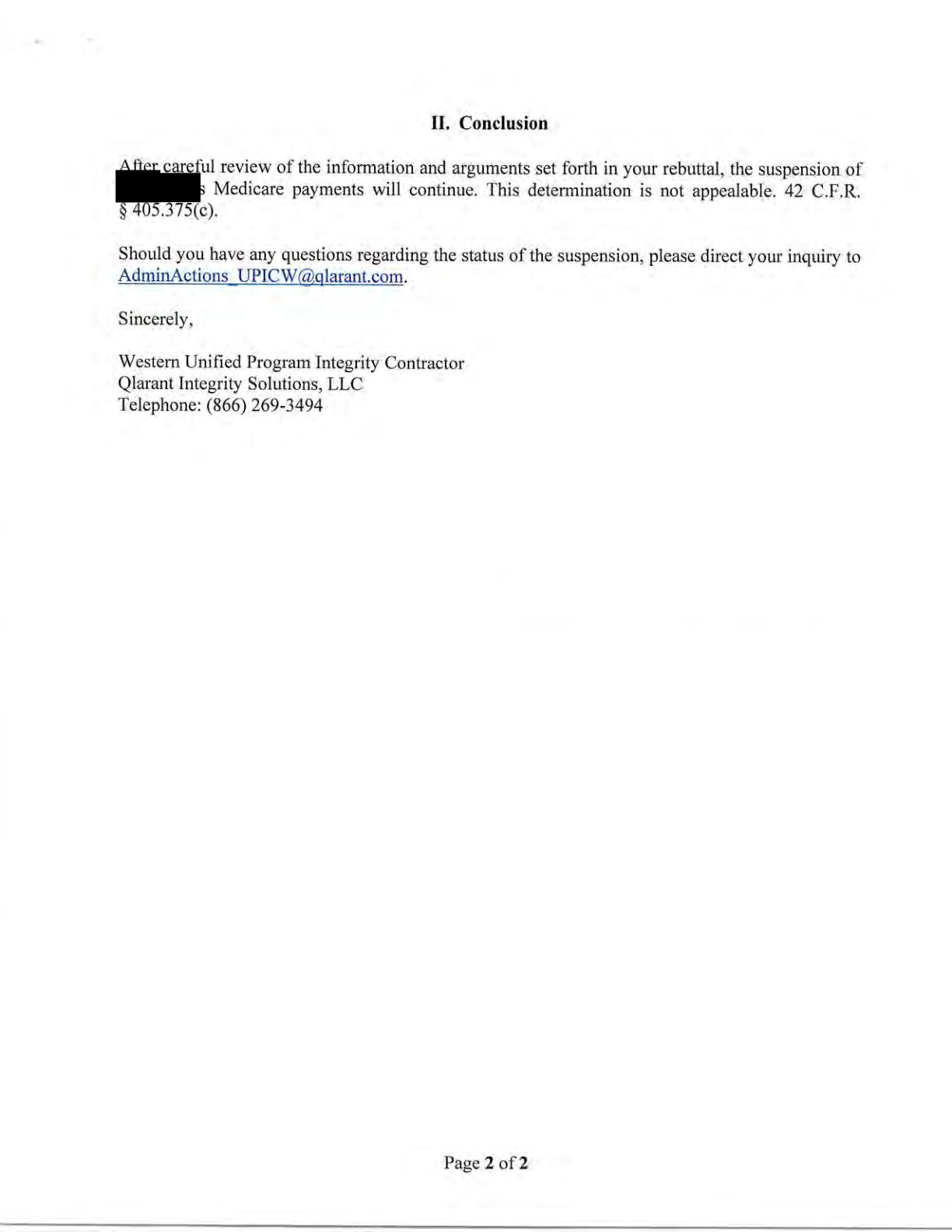
Strip away the citations and the letter makes exactly three moves:
- Your rebuttal was received and reviewed. Both agencies had submitted medical records for the five claim examples cited in their original Notice of Suspension, arguing the services met all applicable Medicare hospice coverage requirements.
- The suspension continues. The operative sentence in both letters: the rebuttal “was not sufficient to refute CMS’s determination that there is a credible allegation of fraud warranting payment suspension in accordance with 42 C.F.R. § 405.370 et seq.” The documentation “did not resolve the credible allegation of fraud identified through the data analysis” — and the suspension is “appropriate pending additional investigation.”
- There is no appeal. “This determination is not appealable. 42 C.F.R. § 405.375(c).” That citation is accurate — more on what it does and does not mean below.
Two Agencies, Two Timelines, One Outcome
What makes the pair of letters worth studying is how different the two agencies’ paths were — and how identical the result was:
| Hospice A | Hospice B | |
|---|---|---|
| Notice of Suspension | April 17, 2026 | March 31, 2026 |
| Rebuttal filed | May 8 (via counsel) | April 10 |
| Medical Review Records Request | — (none observed to date) | July 13 — 30 claims, via Kiteworks |
| Rebuttal denial | July 30 (~12 weeks after rebuttal) | July 27 (~15 weeks after rebuttal) |
| Result | Suspension continues, “pending additional investigation” — not appealable | |
Note the gap. In May we documented suspensions being lifted about three weeks after rebuttal packets went in — one agency cleared in seven days. These two rebuttals sat for three to four months and came back denied. The two-track pattern we flagged in July has now fully materialized: agencies whose rebuttals persuaded got their L3 release on the remittance, often quickly. Agencies whose rebuttals did not are getting a formal denial — months later, in writing, with the investigation explicitly continuing.
Why Your Five Charts Were Never Going to Win
Here is the part every operator (and every operator’s lawyer) should internalize, because it reframes what this letter means: the rebuttal denial says almost nothing about the quality of your rebuttal.
The legal standard for a fraud-based payment suspension is not whether your claims were payable. It is whether a credible allegation of fraud exists — a threshold 42 C.F.R. § 405.371 and § 405.372 set deliberately low, and one CMS gets to evaluate for itself, on its own rebuttal record, with no independent adjudicator involved. Your suspension was triggered by data analysis across your entire claims history — live discharge rates chief among the flags. A rebuttal that proves five individual charts were properly documented does not touch a statistical pattern computed over thousands of claim lines. The letters say this almost in as many words: the records “did not resolve the credible allegation of fraud identified through the data analysis.”
The second letter makes the point vividly, because it quotes the agency’s arguments back before dismissing them. The agency argued its services were “based on clinical assessments, patient eligibility criteria, and in accordance with established Medicare guidelines.” It argued its live discharges “were made with appropriate documentation and communication with the patient, family members, and care team.” It even submitted a 2024–2025 hospice cap acknowledgment letter from National Government Services to prove that patients it was accused of discharging alive had in fact died. Every argument received the same one-sentence answer: not sufficient to refute a credible allegation of fraud.
If you got this letter, the takeaway is not that your attorney failed or your charts were weak. Rebuttal denials in fraud-based suspensions are close to automatic — the stage is nearly unwinnable by design. The winnable fights come later, and they are exactly the ones the denial letter quietly points toward: “pending additional investigation.”
The Detail That Should Worry Shared-Suite Hospices: Your Address Is Evidence Now
One passage in the July 27 letter is, as far as we know, new to this wave — and it deserves its own section. The agency had argued in its rebuttal that it is “an entirely independent entity” with “no affiliations, partnerships, or ownership connections” to any other provider. Qlarant’s answer:
“However, your practice is operating from an address statistically linked to a high volume of administrative actions against other Medicare providers, including payment suspension and revocations. This association, in conjunction with the data analysis findings, poses an undue risk to the Medicare trust funds.”
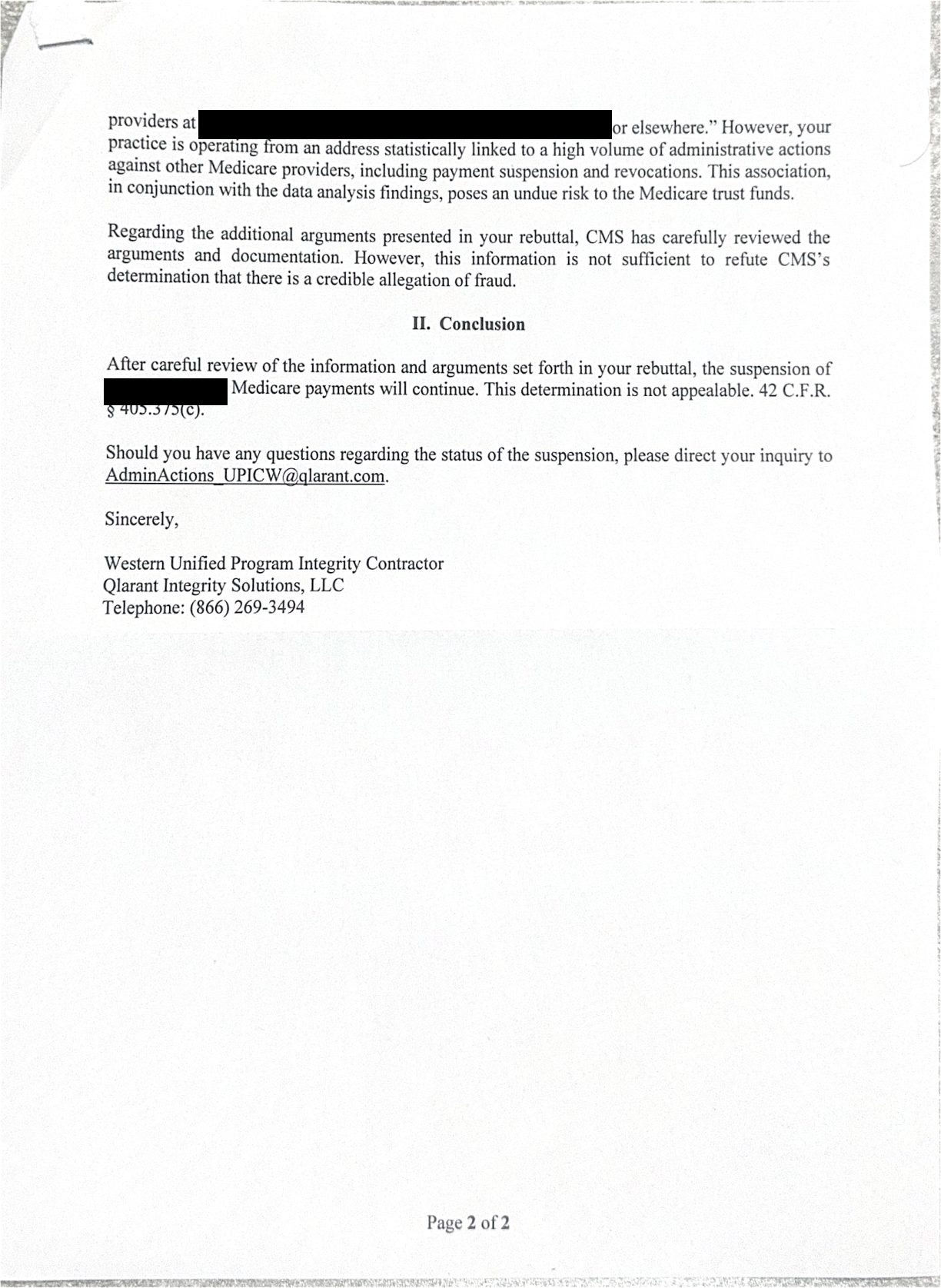
Read that carefully: the hospice’s office suite — not its billing, not its charts — is being cited as a reason the suspension stands. CMS is running address-level analytics: if your suite, building, or registered address has housed other providers that were suspended or revoked, that “association” is now itself a risk factor, layered on top of your claims data. We have written about this direction before — the affiliation-based revocation that cost a clean-billing hospice its enrollment over who it knew, and the FBI’s hospice fraud alert profiling exactly the clustered, storefront-suite operations this analytic is hunting. California’s new licensing rules push the same way: Title 22 now requires hospices to occupy unshared, exclusively possessed office space. If your hospice shares an address with other agencies — especially agencies with enforcement history — that arrangement is no longer just a licensing exposure. It is showing up in federal fraud determinations.
“But We’re Mid-Way Through Our 30-Day Records Window” — the Collision That Confused Everyone
Now the sequencing detail that genuinely confused the second agency — and will confuse others. Hospice B received its Medical Review Records Request on July 13: thirty claims, selected by Statistically Valid Random Sample, complete clinical records due within 30 days via Kiteworks. Fourteen days into assembling that production — deadline still three weeks out — the rebuttal denial arrived by FedEx. The natural reading was alarming: they denied us before even looking at the 30 charts we’re still pulling. Is the review over? Did we just lose it?
No. The two letters are two separate tracks, and neither moots the other:
- The rebuttal track just closed. The denial answers the rebuttal filed back in April against the suspension — the five original claim examples. That question (“should payments stay frozen while we investigate?”) has now been answered, and there is no appeal from it.
- The medical review track is still open — and it is the one that matters. The 30-claim SVRS review of paid claims is the “additional investigation” the denial letter references. Its 30-day clock is unchanged by the denial. Its outcome — a findings letter and, likely, an extrapolated overpayment determination — is the decision that does carry appeal rights. The records request letter itself says the results will come with “an explanation of your right to submit a rebuttal statement,” and an overpayment determination is appealable through the standard five-level Medicare appeals process.
So if the denial lands mid-window: nothing about your records deadline changed. Do not slow the production. Do not conclude the case is lost. If anything, the denial confirms the records review is where the case now lives — every chart in that SVRS sample is carrying extrapolated weight across your entire claims universe, and a complete, organized, on-time submission is the single highest-leverage thing your agency can do.
What “Not Appealable” Does — and Does Not — Mean
The citation is real: under 42 C.F.R. § 405.375(c), a payment suspension determination is not an initial determination and carries no administrative appeal rights. There is no ALJ, no reconsideration, no judicial fast lane out of a suspension. That is by design — the suspension is classified as a temporary protective measure, not a final decision about your money.
But do not over-read it. What you cannot appeal is the decision to keep payments frozen while the investigation runs. What you can eventually fight, with full appeal rights and an independent adjudicator, is the overpayment determination that typically emerges from the medical review. The escrowed payments accumulating during your suspension are applied against whatever overpayment is ultimately assessed — and if the suspension is lifted with money left over, it comes back, often announced by nothing more than a negative L3 adjustment on your remittance. Counsel also retains moves inside the suspension itself: CMS must periodically re-evaluate a fraud-based suspension (they run in 180-day increments), and a good-cause termination request is available when the investigation stalls or circumstances change.
The Playbook: What to Do the Week This Letter Arrives
- Reset expectations internally — this outcome was the norm. Share the two-track picture with your leadership and your lender before panic sets in. The denial changed nothing about your operations that was not already true the day before.
- Put everything into the records review. If a Medical Review Records Request has arrived, treat it as the most important document production in the company’s history: reconcile the beneficiary list line by line, chase referring-physician and facility records first (they are slowest), assemble per-beneficiary, submit on time with a paper trail. If it has not arrived, assume it is coming and watch the Kiteworks inbox daily.
- Run your own data analysis before Qlarant shows you theirs. The pattern that flagged you is in your own claims: live discharge rate, length of stay, revocation-window returns, visit intensity. Knowing which measure you are an outlier on tells you which sampled charts are vulnerable and what the overpayment theory will be — before the findings letter writes it for you.
- Model the cash runway honestly. Fraud-based suspensions renew in 180-day increments and routinely do. Plan for a year or more without Medicare receipts: escrow ledger, payroll runway, census decisions. Our cash-flow survival playbook covers the mechanics. More hospices die of the cash crunch than of the eventual overpayment.
- Keep billing — and bill perfectly. Claims submitted during suspension adjudicate into escrow and offset whatever is assessed. Every one of them is under a microscope: tight eligibility narratives, timely face-to-face encounters, visit frequencies that match the plan of care. Clean post-suspension claims also quietly undercut an “ongoing fraud” narrative.
- Audit your address and affiliations exposure. After the July 27 letter, this is no longer theoretical. Who else operates — or operated — at your address? What is their enforcement history? Does anyone with managing control hold roles at other providers? California hospices should already be moving on the exclusive-office-space rule; the same fix now has federal significance.
- Route the fight through counsel — and preserve everything. A continued fraud-based suspension carries real OIG/DOJ referral risk. No cleanup, no after-the-fact “corrections” to existing charts — late additions must be clearly dated addendums or they read as spoliation. Communications with Qlarant go through one channel, on paper, through your attorney.
Where This Leaves the Wave
The 2026 Qlarant wave now has a nearly complete arc, and every phase has announced itself with less ceremony than the last: the suspension letter, the 15-day rebuttal, the quiet lifts on the remittance, the unannounced site visits, the Kiteworks records requests — and now, for agencies still frozen, a FedEx envelope saying the rebuttal lost and the investigation continues. If that envelope has reached you, the case is not over. It has simply moved to the phase where the record you build — chart by chart, claim by claim — finally gets read by someone obligated to weigh it. Build it like everything depends on it, because from here, it does.
CDPH Emergency Regulation Changes — Live Q&A This Wednesday at 10:00 AM Pacific
Wednesday, September 23 · 40 minutes · Hosted by Miles Pickens, Hospice Engine
Bring your questions on CDPH’s emergency hospice licensing regulations (Title 22) — nurse ratios, management qualifications, CHOW, and the licensing moratorium. Zoom link sent by email when you register. The first 3 seats each Wednesday session are free.
Rebuttal Denied and a Records Request on the Clock?
Our team has supported hospices through every phase of the 2026 Qlarant wave — rebuttals, extensions, lifts, site visits, and medical review productions. We help agencies read their own claims data the way Qlarant does, reconcile the beneficiary list, QA sampled charts the way a reviewer reads them, and assemble a per-beneficiary submission that meets the format rules — inside whatever EMR you already run.
Talk to Our Team The Records Request, Decoded