
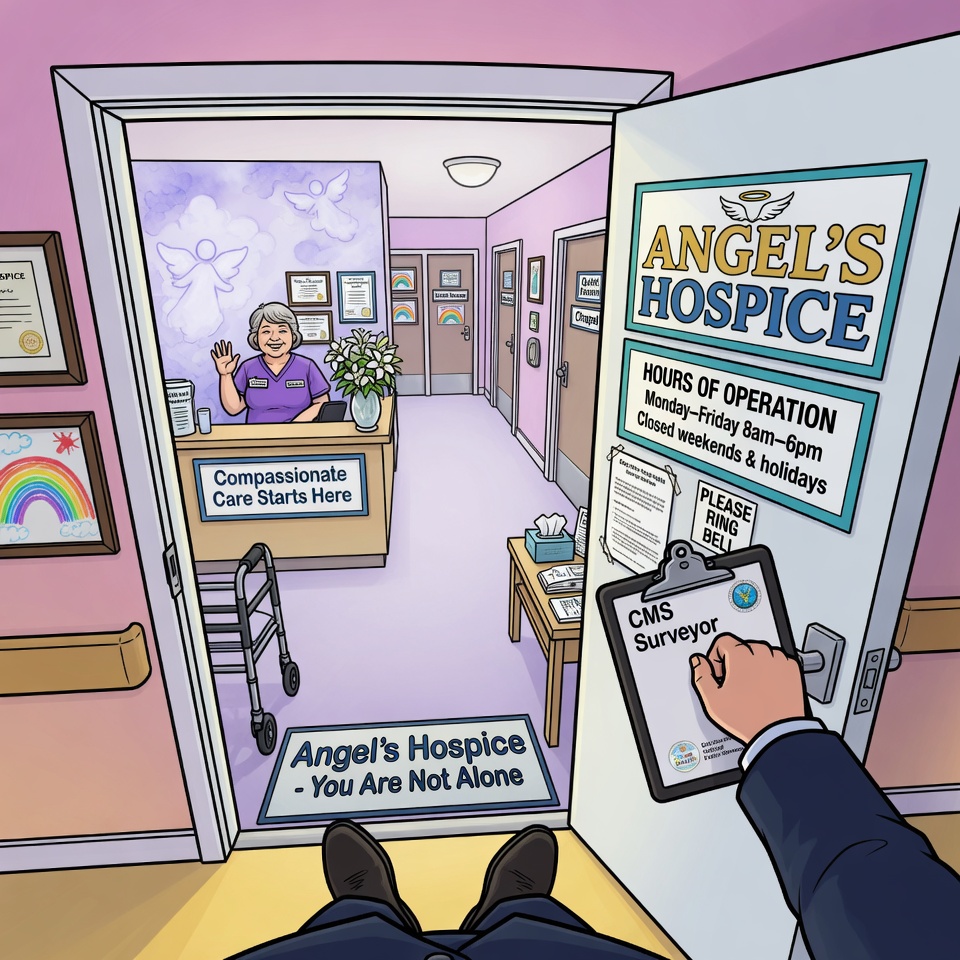
For hospices coming out of the April 2026 Qlarant suspension wave, getting the payment suspension lifted feels like the finish line. It isn’t. We’re now seeing a consistent next step across agencies in the current wave: an unannounced, in-person site visit from a Qlarant/CMS representative, timed right around the suspension lift. If your front desk isn’t expecting it, a routine visit can turn into a new problem. Here’s when it happens, exactly what they ask for, and how to be ready.
First: What the Suspension-Lift Notice Actually Says
Before the visit comes the letter. The notice arrives from the Western Unified Program Integrity Contractor (UPICW) — Qlarant Integrity Solutions, LLC, and it confirms CMS has “commenced the process to terminate the suspension of your Medicare payments.” Here is a representative example (identifying details omitted):
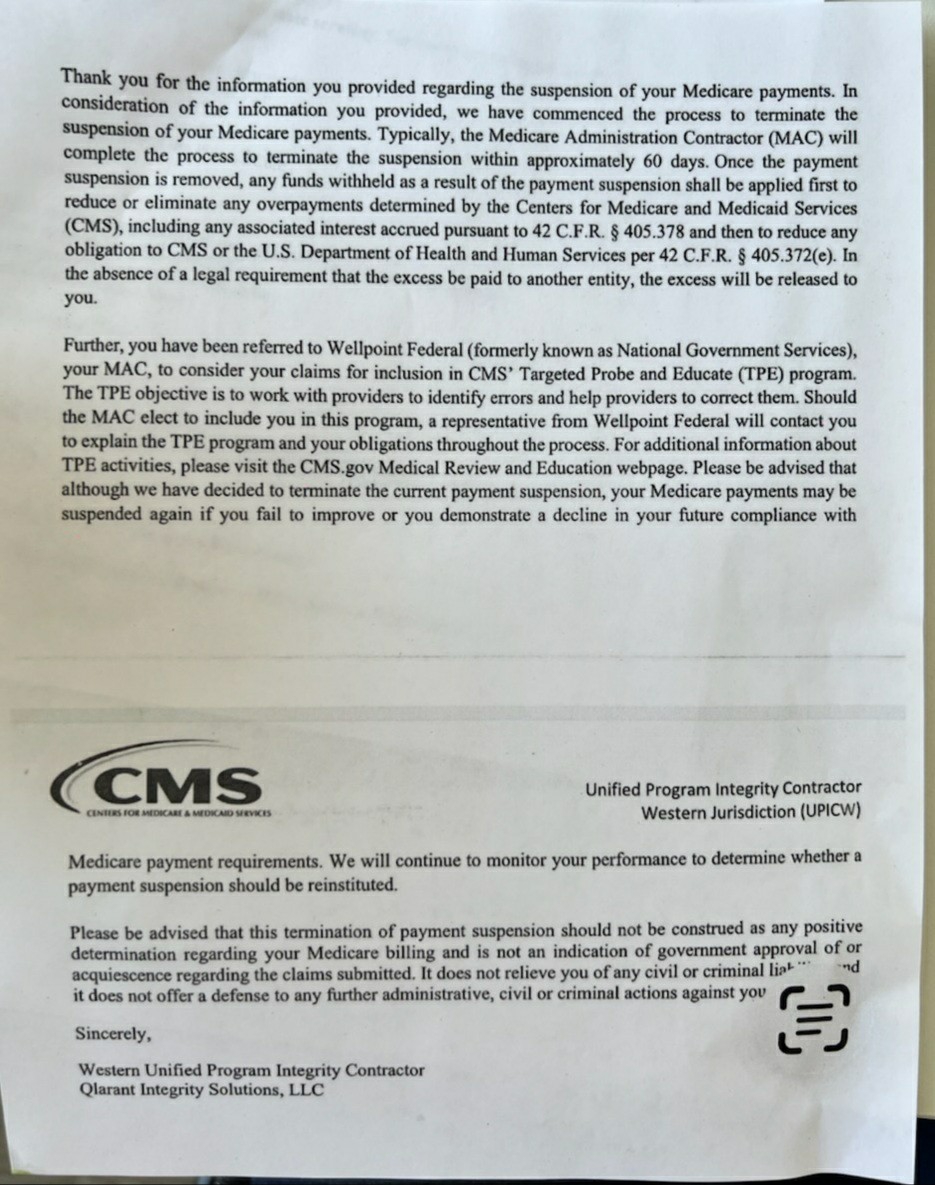
Four things in that letter matter for what comes next:
- The MAC completes the termination in ~60 days. “Lifted” is the start of a process, not an instant switch — your Medicare Administrative Contractor finishes it, typically within about 60 days.
- Your withheld money comes back — net of overpayments. Funds held during the suspension are applied first to any overpayments and accrued interest CMS determines; the excess is released to you.
- You’re handed to TPE. The notice refers you to your MAC (Wellpoint Federal, formerly National Government Services) for the Targeted Probe and Educate (TPE) program — ongoing claim review and education.
- It can come back. The letter explicitly warns your payments “may be suspended again” if you fail to improve or your compliance declines, and that the termination is not a positive determination and does not relieve you of civil or criminal liability.
In other words, lifting the suspension flips you from suspended to actively monitored. The unannounced site visit is part of that monitoring posture — CMS confirming, in person, that you are a real, operating hospice.
CDPH Emergency Regulation Changes — Live Q&A This Wednesday at 10:00 AM Pacific
Wednesday, October 14 · 40 minutes · Hosted by Miles Pickens, Hospice Engine
Bring your questions on CDPH’s emergency hospice licensing regulations (Title 22) — nurse ratios, management qualifications, CHOW, and the licensing moratorium. Zoom link sent by email when you register. The first 3 seats each Wednesday session are free.
The New Step: An Unannounced Site Visit
Based on what agencies in the current wave are telling us, the visit happens in one of two windows:
- While your rebuttal packet is still under review, or
- Soon after the review wraps up — in the cases we’ve seen, up to about a week after you receive the suspension-lift notice.
It is unannounced. No appointment, no phone call, no heads-up. A representative simply shows up at your physical office during business hours. That is by design — the point is to see your operation as it actually runs on a normal day.
Exactly What the Representative Asks For
Across the visits we’re hearing about, the requests are consistent. Have these ready:
- An updated employee list. A current staff roster — proof you are genuinely staffed to provide care.
- What software you use. They ask which EMR/clinical-and-billing system you run, and take a photo of the login screen — confirmation you have a real, operating system of record.
- Your current state license. It needs to be current; have it accessible (and ideally posted).
- Medical supplies. Physical evidence that you stock supplies on-site for patient care.
- Business cards. Basic indicia of a legitimate, operating business.
- Your current census. Your active patient census, ready to produce on the spot.
- Photos of the office — and your posted hours. The representative photographs the office and the hours of operation posted at the door.
How to Turn the Surprise Into a Non-Event
None of this is hard to pass — if you’re ready before they arrive. A short prep checklist:
- Post your hours of operation at the entrance — and actually keep them. This is the single most common photo they take.
- Keep your state license current and displayed.
- Be able to produce an updated employee roster and current census in seconds. Your EMR should generate both on demand — in Hospice Engine, they’re a couple of clicks.
- Keep a reasonable stock of medical supplies on-site.
- Have business cards available at the front desk.
- Know your EMR login and be able to pull up the system to show it.
- Brief your front-desk and office staff now. Make sure whoever greets visitors knows this can happen, knows to notify the administrator immediately, and understands that calm, professional cooperation is the right posture. A flustered “we can’t show you anything” reads worse than a prepared welcome.
Why This Matters
The site visit dovetails with the TPE referral and the “may be suspended again” language in the lift notice. The whole point of the suspension wave was to find paper hospices and shell operations — agencies that bill Medicare without genuinely operating. An in-person visit is the cleanest way to verify the opposite: that there are real staff, a real system, real supplies, a real census, and real hours at a real address. For a legitimate operator, that’s a visit you want to ace. The only way to fail it is to be caught flat.
Coming Out of a Suspension? Get Your Operation Visit-Ready.
Our team helps hospices through the full Qlarant lifecycle — the 15-business-day rebuttal, the post-lift TPE referral, and getting your office, records, and census ready for an unannounced visit. The same data and documentation work, applied before anyone knocks on your door.
Schedule a ConsultationRelated Reading
- How Long Until Your Qlarant Suspension Is Lifted?
- After the Qlarant Suspension Is Lifted: What Hospices Are Actually Facing Next
- Got a Qlarant “Notice of Suspension”? The 15-Business-Day Rebuttal Playbook
- CMS Pauses Medicare Payments for 447 California Hospices: What the Qlarant Letter Means
This article reflects what hospices in the April 2026 Qlarant wave are reporting and what we are seeing in the field; the unannounced site visit is an operational practice we are observing, not a line in a published regulation. Confirm specifics with your own counsel and your MAC. The lift-notice image is a representative example with recipient-identifying details omitted.