
Three months into the April 2026 Qlarant wave, outcomes are splitting into two very different tracks. Some hospices have been released — the L3 reversal on the remittance, the unannounced site visit, payments flowing again. Others are still frozen. And for at least some of those still-suspended agencies, a new letter has started arriving: a Medical Review Records Request — a full clinical-record audit of claims Medicare already paid, built on a statistical sample, due in 30 days, and delivered not by certified mail but through Kiteworks. We just reviewed one, dated July 13, 2026, sent to a California hospice whose suspension is still in place. Here is what it says, why the phrase “Statistically Valid Random Sample” is the most consequential sentence in it, and why every suspended hospice should be watching its inbox.

CDPH Emergency Regulation Changes — Live Q&A This Wednesday at 10:00 AM Pacific
Wednesday, October 14 · 40 minutes · Hosted by Miles Pickens, Hospice Engine
Bring your questions on CDPH’s emergency hospice licensing regulations (Title 22) — nurse ratios, management qualifications, CHOW, and the licensing moratorium. Zoom link sent by email when you register. The first 3 seats each Wednesday session are free.
The Wave Is Splitting Into Two Tracks
Here is the pattern we are seeing across agencies we work with, and it is worth stating plainly: not everyone gets this letter. We know of providers from the April wave whose suspensions were lifted — rebuttal in, funds released, site visit done — without a medical review records request ever arriving. For them, the suspension appears to have been the whole event.
The agency that received the July 13 letter is on the other track. It received the original Notice of Suspension in the spring and submitted its rebuttal — five charts — in late April, roughly two weeks ahead of other still-suspended agencies we know. Its payment suspension remains in place. Now, about eleven weeks after the rebuttal went in, comes a demand for the complete clinical record on 30 claims across 19 patients.
And one composition detail jumps out: two of the 19 patients were among the five charts in the original rebuttal — but the new request covers different service months than the ones already reviewed. Qlarant looked at those patients once, and is now coming back for the rest of their enrollment.
That pattern fits how program-integrity reviews typically escalate. A small initial chart request often functions as a probe: if the probe charts hold up, the contractor can close out and release; if they raise questions, the next step is a statistically valid sample built for extrapolation. We cannot confirm Qlarant’s logic from one case — and part of the fork may be simple queue position, since this agency’s rebuttal went in earlier than most and other agencies’ letters may still be working through the pipeline. But the working theory that best fits what we can see is that the rebuttal charts were the audition: agencies whose charts cleared got their L3 release, and agencies whose charts left questions open are getting the deeper look.
One detail in the letter quietly connects the two: the contact Qlarant gives for questions about the records request is suspensions.upicw@qlarant.com — the suspensions inbox. The medical review and the suspension are not separate storylines. A payment suspension under 42 CFR § 405.370–375 exists to protect Medicare’s money while a review happens. If your suspension has not lifted, this letter is a strong candidate for what it has been waiting on.
Either way, the practical takeaway is the same: if your suspension has not lifted, plan as if this letter is coming. And what we can tell you exactly is what it demands when it does — because the stakes it describes are unlike anything else in this wave so far.
What the Letter Is: A Reopening of Claims You Were Already Paid For
The letter is titled “Medical Review Records Request” and comes from Qlarant Integrity Solutions as the Unified Program Integrity Contractor (UPIC) for the Western Jurisdiction — the same authority behind the suspension letters, covering California and fifteen other states and territories. Here is the first page of the actual letter, with the agency’s identifying information removed:
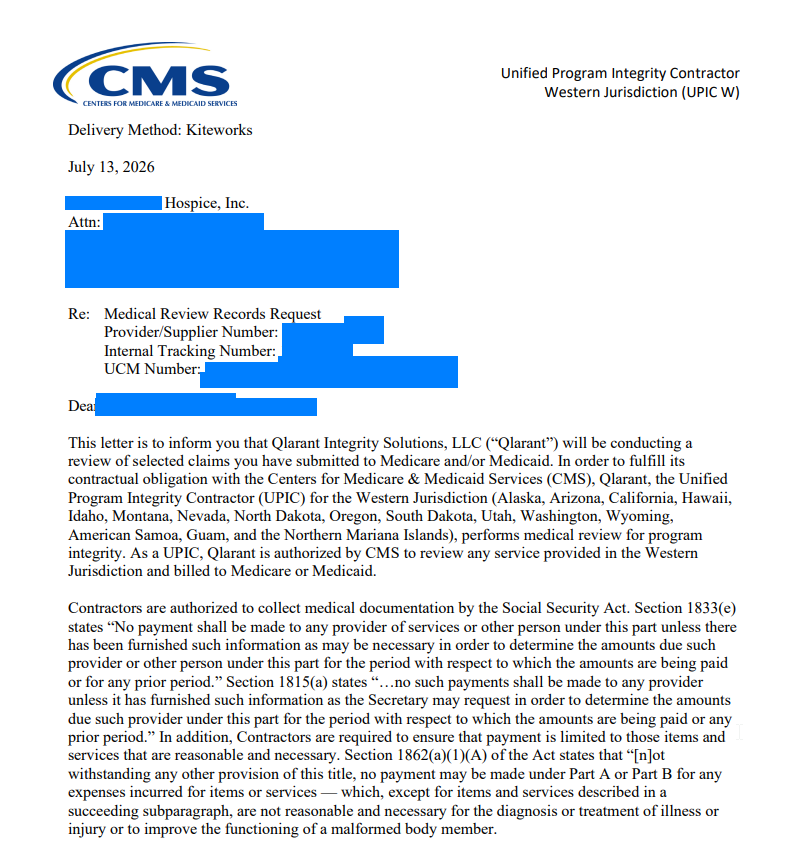
Three things define it:
- It reaches backward, not forward. Qlarant cites 42 CFR § 405.986 — the authority to reopen claims after payment when there is good cause. These are not pending claims being held for review. These are claims Medicare already paid, being re-adjudicated.
- The claims were chosen statistically. The letter states the reviewed claims were “selected from a computer-generated Statistically Valid Random Sample (SVRS)” drawn from “the universe of your claims.” More on why that phrase matters below — it is the whole ballgame.
- The burden of proof is entirely yours. The letter is explicit that as the billing provider you are responsible for producing all documentation supporting medical necessity — including records held by other facilities. If a referring physician’s notes support your terminal certification, obtaining them is your job, inside the same 30 days.
“Statistically Valid Random Sample”: the Phrase That Turns 30 Charts Into Millions
Buried in the letter’s consequences section is the sentence every administrator should read twice:
“Any overpayment identified in a Statistically Valid Random Sample (SVRS) may be projected to the universe of claims processed during the time frame described above.”
In plain terms: the sample stands in for everything. Qlarant’s clinical reviewers do not need to review every claim you billed. They review the sampled charts, compute a denial rate, and are authorized to extrapolate that rate across every dollar Medicare paid you in the review period. In the letter we reviewed, the sample is 30 claims across 19 patients — which means each sampled claim carries more than 3% of the denial rate that gets projected onto everything else.
A simplified, hypothetical illustration of the arithmetic — not this provider’s numbers:
| Sampled claims reviewed | 30 claims · $150,000 paid |
| Sampled dollars denied on review | $60,000 (40%) |
| Universe: all claims paid in the review period | $6,000,000 |
| Extrapolated overpayment demand | on the order of $2,400,000 |
That is why this letter deserves more respect than an ordinary ADR. A routine additional-documentation request puts the sampled claims at risk. An SVRS review puts the review period at risk. Every chart in the sample is carrying the weight of hundreds of claims that will never be individually reviewed — which means every missing face-to-face note, every unsigned certification, every thin recert narrative in those sampled charts gets multiplied.
The 30-Day Clock — and the Ladder Below It
The documentation is due within 30 days of the date on the letter. Not 30 days from when you saw it. For a letter dated July 13, the window closes in mid-August whether or not anyone at the agency has opened it.
If records are not submitted in time, the services are treated as “non-verifiable” — and the letter enumerates what can follow:
- A determination that an overpayment has been made — extrapolated to the universe, as above;
- A request for payment suspension under 42 CFR § 405.371(a)(1) — and for an agency already suspended, continued suspension;
- Revocation of Medicare billing privileges under 42 CFR § 424.535(a)(10) for failure to comply with a records request;
- Referral to the OIG for potential exclusion from all federal health care programs.
Note what that ladder means in practice: silence is the worst possible response. A chart with imperfect documentation might survive clinical review; a chart never submitted is an automatic, extrapolatable denial plus a revocation trigger. If the deadline is genuinely impossible, the letter itself says to contact Qlarant immediately — the same move we documented for rebuttal extensions, and it has to happen before the window lapses.
It Arrives by Kiteworks — So Monitor the Inbox Qlarant Has on File
Here is the operational detail that motivated this post. The letter’s stated delivery method is Kiteworks — Qlarant’s secure file-transfer platform. Not certified mail. Not a process server. A secure-link email, sent to the address Qlarant has on file for your agency.
Think about what that means for a busy, cash-strapped agency under suspension. The most consequential letter of the entire investigation — the one with a hard 30-day clock and a seven-figure downside — can arrive as one more email in a general inbox, from a sender most staff have never heard of, easily mistaken for phishing or ignored entirely. And the clock runs from the letter date regardless.
If your hospice is under a Qlarant suspension right now:
- Identify the email address Qlarant is using for your agency — check your original Notice of Suspension; it is typically the correspondence address from your enrollment file. If that is a generic inbox, assign a named person to check it every business day.
- Whitelist the domains. Make sure mail from qlarant.com and Kiteworks notification addresses cannot land in spam. Search your spam folder for “Qlarant” and “Kiteworks” today — and calendar a weekly re-check.
- Treat any Kiteworks notification as same-day urgent. Download the contents immediately — secure links expire — and log the letter date, because every deadline keys off it.
- Confirm you received the beneficiary list. This one comes from direct experience: the letter’s claim details live in a separate enclosure — the “Beneficiary list” — not in the letter body. The four-page letter we reviewed contains no patient names and no claim numbers at all. If you download the letter but miss the second file, you have a 30-day clock and no idea which charts to pull. If the list is not with the letter, email Qlarant the same day (no PHI in the email) and paper-trail the request.
What Qlarant Asks For — the Complete Story of Each Patient
The request is not a claim-form audit; it is the full clinical narrative. The letter’s documentation list (which it warns is “not all inclusive”):
- Initial Certification form and all recertification documentation;
- Beneficiary Election form;
- Signature attestations for all personnel providing services;
- Face-to-face encounter documentation;
- Medical evidence supporting the initial certification of a terminal condition — including the referring physician’s notes and records;
- RN, Social Worker, and Chaplain initial assessments;
- The care plan, visit notes, and interdisciplinary meeting notes;
- Phone notes, medication list/record, and lab results where applicable.
Notice the shape of that list: it is everything a reviewer needs to second-guess eligibility — was this patient terminally ill, was it properly certified, supported by the referring physician’s own records, and did the care delivered match the story. For a wave triggered by live-discharge outliers, that is exactly the fight you should expect the review to be about.
The submission mechanics have teeth, too: records must be separated by individual beneficiary (one combined PDF is explicitly rejected), email submission is prohibited entirely, and the preferred channel is the same Kiteworks portal — with esMD and mail as alternatives. Sloppy assembly costs processing time you do not have.
The First 72 Hours If This Letter Lands
- Log the letter date and calendar the deadline — day 30 from the letter date, with an internal target a week earlier for assembly and QA.
- Verify the beneficiary list is in hand and reconcile it: how many patients, which dates of service, which are still on service versus discharged, and whether any records live with other facilities or the referring physician — those external requests go out first because they are the slowest. Flag any patients who appeared in your original rebuttal: in the letter we reviewed, two rebuttal patients reappeared in the sample with different service months, meaning the review expanded to the rest of their enrollment.
- Assign an owner. One person accountable for the production: chart pulls, external records, per-beneficiary assembly, submission confirmation.
- Read the sampled charts the way a reviewer will — eligibility first: certification signatures and dates, F2F timing, recert narratives, whether the documented decline supports terminal prognosis. Know your weak charts before Qlarant does; where documentation is thin, a physician narrative or addendum prepared now (clearly dated as such) beats silence.
- If the deadline is impossible, ask for more time in writing, immediately — before day 30, to the contact on the letter, with a paper trail.
A deeper how-to on building a records package that survives an SVRS review — chart-by-chart QA, external records, assembly and submission — is coming as a follow-up post.
If You’re Still Suspended, Assume You’re on This Track
The lesson of this wave keeps repeating: each phase announces itself with less ceremony than the last. The suspension came as a letter; the lift, for some, arrived as a single line on a remittance; the site visit came unannounced. The medical review — the phase with the largest dollars attached — arrives as a secure-link email with a clock already running.
If your suspension has lifted, this letter may never come; we know agencies for which it did not. But if you are still frozen months after your rebuttal, the working assumption should be that your claims are being — or will be — reviewed, and that the notice will arrive quietly. Watch the inbox. Verify the beneficiary list. And treat the 30 days as the hardest deadline of the entire investigation, because it is the one where the sample speaks for everything.
CDPH Emergency Regulation Changes — Live Q&A This Wednesday at 10:00 AM Pacific
Wednesday, October 14 · 40 minutes · Hosted by Miles Pickens, Hospice Engine
Bring your questions on CDPH’s emergency hospice licensing regulations (Title 22) — nurse ratios, management qualifications, CHOW, and the licensing moratorium. Zoom link sent by email when you register. The first 3 seats each Wednesday session are free.
Facing a Records Request While Your Payments Are Frozen?
Our team has supported hospices through every phase of the 2026 Qlarant wave — rebuttals, extensions, lifts, site visits, and now medical review responses. We help agencies reconcile the beneficiary list, QA the sampled charts the way a reviewer reads them, chase down referring-physician records, and assemble a per-beneficiary submission that meets Qlarant’s format rules — inside whatever EMR you already run.
Talk to Our Team What Happens After the Lift