
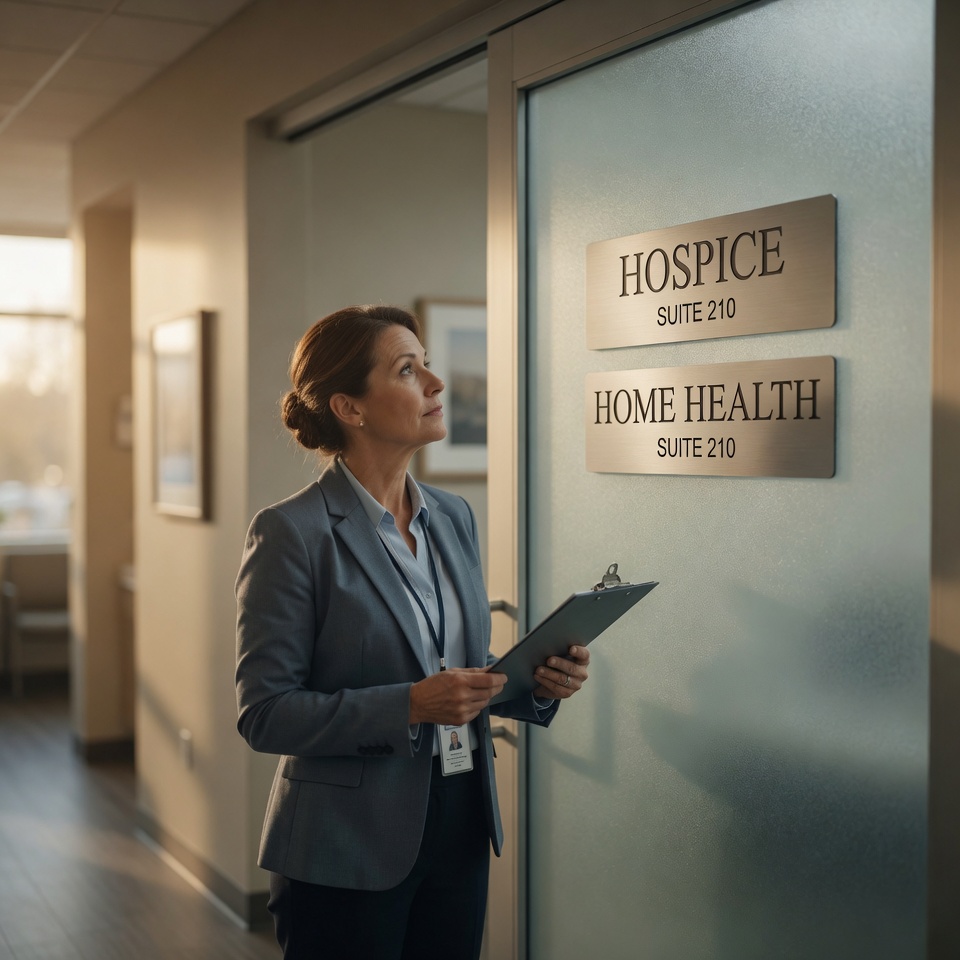
Running a hospice and a home health agency out of the same office is one of the most ordinary arrangements in California home-based care. One lease, one front desk, one set of lights — two licenses under one roof. Nobody built it to hide anything; they built it to save rent. But California’s new hospice rulebook — Title 22 CCR sections 74800–74908, live since June 22 — just quietly turned that shared office into a citable deficiency. And most operators who are doing it have no idea.
This is the natural next question after our last post on whether one leader can run both a hospice and a home health agency (they can). A webinar guest pushed further: “What about the building itself — if it’s the same company, same Tax ID, can the hospice and the home health just be in the same office?” We went to the regulatory text. The answer is sharper than most people expect: same building, yes — same office, no — and being one entity doesn’t save you. Here is exactly what the rule says, how many California operators are exposed right now, and the clean way to fix it.
CDPH Emergency Regulation Changes — Live Q&A This Wednesday at 10:00 AM Pacific
Wednesday, October 14 · 40 minutes · Hosted by Miles Pickens, Hospice Engine
Bring your questions on CDPH’s emergency hospice licensing regulations (Title 22) — nurse ratios, management qualifications, CHOW, and the licensing moratorium. Zoom link sent by email when you register. The first 3 seats each Wednesday session are free.
What the Rule Actually Requires
There is exactly one section that governs your physical location, and a definition that sets its tone. Start with the definition — § 74800(22):
“‘Established place of business’ means unshared office space located in a commercial building.”
Then the operative rule, § 74908, “Hospice Office Space,” which was adopted as part of the emergency package:
“(a) A hospice must have office space that is an established place of business and must:
(1) Be an unshared space where the licensee has exclusive possession.
(2) Located in a commercial building that is either owned by the licensee or leased or subleased exclusively by the licensee for a minimum of 12 consecutive months.”
And subsection (b) tells you the space has to look and function like a real, dedicated hospice office — including:
“(b)(1) Permanently attached signage that identifies the name of the hospice as indicated on the license… Signage must be visible to the public, and must be posted on the exterior and in the interior of the office space.”
Subsection (b) goes on to require posted business hours, an active business telephone line answered 24 hours a day, seven days a week, and secure storage for the hospice’s patient medical records (b)(7), medications (b)(8), and personnel records (b)(9). This is the section CDPH built to end the “shared address, no sign, empty suite” pattern the State Auditor found. But read literally — and surveyors read literally — it reaches a lot further than the shell operators it was aimed at.
The Distinction That Decides It: Building vs. Office
Every operative word in § 74908 describes the hospice’s own space, not the address on the mailbox: “unshared,” “exclusive possession,” “exclusively by the licensee.” Nothing in sections 74800–74908 requires a unique street address, and nothing bars two licensed health businesses from sitting in the same commercial building. So:
- Same building / same street address — permitted. A hospice and a home health arm can share an address, a lobby, even a floor.
- Same office space — not permitted. If the hospice and the home health agency run out of the same suite, the same rooms, the same desks, then the hospice does not have “exclusive possession” of “unshared” space. That is a § 74908 deficiency on its face.
“But It’s All One Company, One Tax ID” Doesn’t Save You
This is the part operators get wrong. The instinct is: if the hospice and the home health are the same legal entity, then the space isn’t really “shared” — it’s all ours. The rule doesn’t work that way. Section 74908 is written to “the licensee” — and that means the hospice license, not the corporation and not the taxpayer. A home health agency holds a separate license even when one company owns both under a single Tax ID. The requirement is that the hospice license exclusively possesses its own unshared space. Put a separately licensed home health operation into that same space — even your own — and the hospice no longer has it to itself. You can’t share a room “with yourself” out of the requirement.
Notice, too, that the signage rule cuts the same way. Subsection (b)(1) demands permanent interior and exterior signage in the hospice’s licensed name. A single unmarked suite that quietly houses both operations fails twice over — once on “unshared,” once on signage.
This Isn’t Hypothetical: The Exposure Is Sitting There Right Now
We wanted to know whether this is a real, present problem or a paper one. So we pulled CMS’s public Care Compare provider directories — every Medicare-certified hospice and home health agency in California — and matched them on normalized street address and suite. The picture is stark:
- California has roughly 2,060 Medicare-certified hospices and 3,150 home health agencies.
- 87 distinct street addresses currently house both a licensed hospice and a licensed home health agency.
- Of those, 27 share the identical suite or unit number — the exact co-located footprint § 74908 now treats as a deficiency.
And these cluster the way you’d expect. In one Glendale office building we found two separate hospices, each paired with a home health agency at its own suite; a Burbank building showed the same doubling. The 27 aren’t all storefront shells, either — the list runs from small independents right up through regional health systems that have simply always kept their hospice and home health teams in one office. That’s the point: this rule catches the legitimate operator just as cleanly as the shell. Doing nothing wrong is not a defense to occupying the wrong kind of space.
How to read that 27. It is a floor, not a ceiling. Care Compare lists only Medicare-certified providers, so state-licensed agencies that aren’t certified don’t appear. Our match also required the suite text to line up exactly, and it ignored same-building-different-suite co-locations (the other 60 of the 87). The true number of California operators with a hospice and a home health agency in one office is higher than 27 — we’re only counting the ones the public data can prove.
Why CDPH Wrote It This Blunt
None of this is an accident of drafting. The California State Auditor’s hospice work found agencies that shared a single address, posted no license or signage, and had none of the infrastructure of a functioning provider — the “hospice mill” pattern behind the licensing moratorium. Section 74908 is the direct answer: force every hospice into real, dedicated, signed, exclusively held space so a paper agency can’t hide inside someone else’s suite. CDPH also cross-references operators tied to multiple licensed entities during review, so a shared footprint doesn’t just sit in a file — it surfaces. The rule is blunt on purpose. The cost of that bluntness is that ordinary operators who co-located to save money are swept in alongside the bad actors.
The Fix: Same Building, Separate Space
The good news is that § 74908 hands you the compliant structure in its own text — the phrase “subleased exclusively by the licensee.” You do not have to move your hospice to a different address or a different town. You have to give it its own space. Concretely:
- Carve out an exclusive, demarcated unit for the hospice — its own suite, its own rooms — not an open floor it shares with the home health team.
- Paper it with an exclusive lease or sublease in the hospice’s name, for a minimum of 12 consecutive months. A common parent can hold the master lease on the whole building and sublease the hospice’s unit exclusively to the hospice — the rule expressly contemplates exactly this.
- Post permanent interior and exterior signage in the hospice’s licensed name, visible to the public, plus posted business hours and a 24/7 business phone line.
- Give the hospice its own secure storage for patient records, medications, and personnel files — not co-mingled with the home health agency’s.
- Disclose the affiliated home health agency. The application content rules require you to list every home health agency the parent organization operates (§ 74812(c)(12)(C)) and every other agency you’re licensed for, operate, manage, or hold a five-percent-or-greater interest in (§ 74812(c)(13)). Co-location is visible to CDPH by design — so make it clean and disclosed, not something a surveyor discovers.
A 60-Second Self-Audit
Walk your own office and answer three questions:
- Does the hospice occupy space that is exclusively the hospice’s — or does the home health agency work out of the same rooms?
- Is there permanent signage in the hospice’s licensed name on both the exterior and the interior?
- Is the space owned, leased, or subleased exclusively by the hospice for at least 12 months — and can you produce that document today?
The Bottom Line
To answer the webinar guest directly: your hospice and your home health agency can be in the same building — but not in the same office — and having one owner and one Tax ID does not change that. Section 74908 requires the hospice to hold unshared space in its own exclusive possession, under its own signage, on its own lease. It’s a rule written to kill hospice mills, but it lands on every operator who ever put two care-at-home licenses under one roof to save a little rent. If that’s you, the fix isn’t a move — it’s a demarcated unit, an exclusive sublease, and a sign. Get it done before a surveyor does it for you.
CDPH Emergency Regulation Changes — Live Q&A This Wednesday at 10:00 AM Pacific
Wednesday, October 14 · 40 minutes · Hosted by Miles Pickens, Hospice Engine
Bring your questions on CDPH’s emergency hospice licensing regulations (Title 22) — nurse ratios, management qualifications, CHOW, and the licensing moratorium. Zoom link sent by email when you register. The first 3 seats each Wednesday session are free.
Run a Hospice and a Home Health Agency From One Office?
Our team helps California operators map their physical footprint against the CDPH emergency regulations — so a hospice and home health agency that legitimately share a building are structured with the exclusive, signed, separately leased hospice space § 74908 now demands. We work alongside whatever EMR you run today, and we’ve guided agencies through state and federal hospice oversight since 2012.
Talk to Our Compliance Team The Full CDPH Rulebook Breakdown