
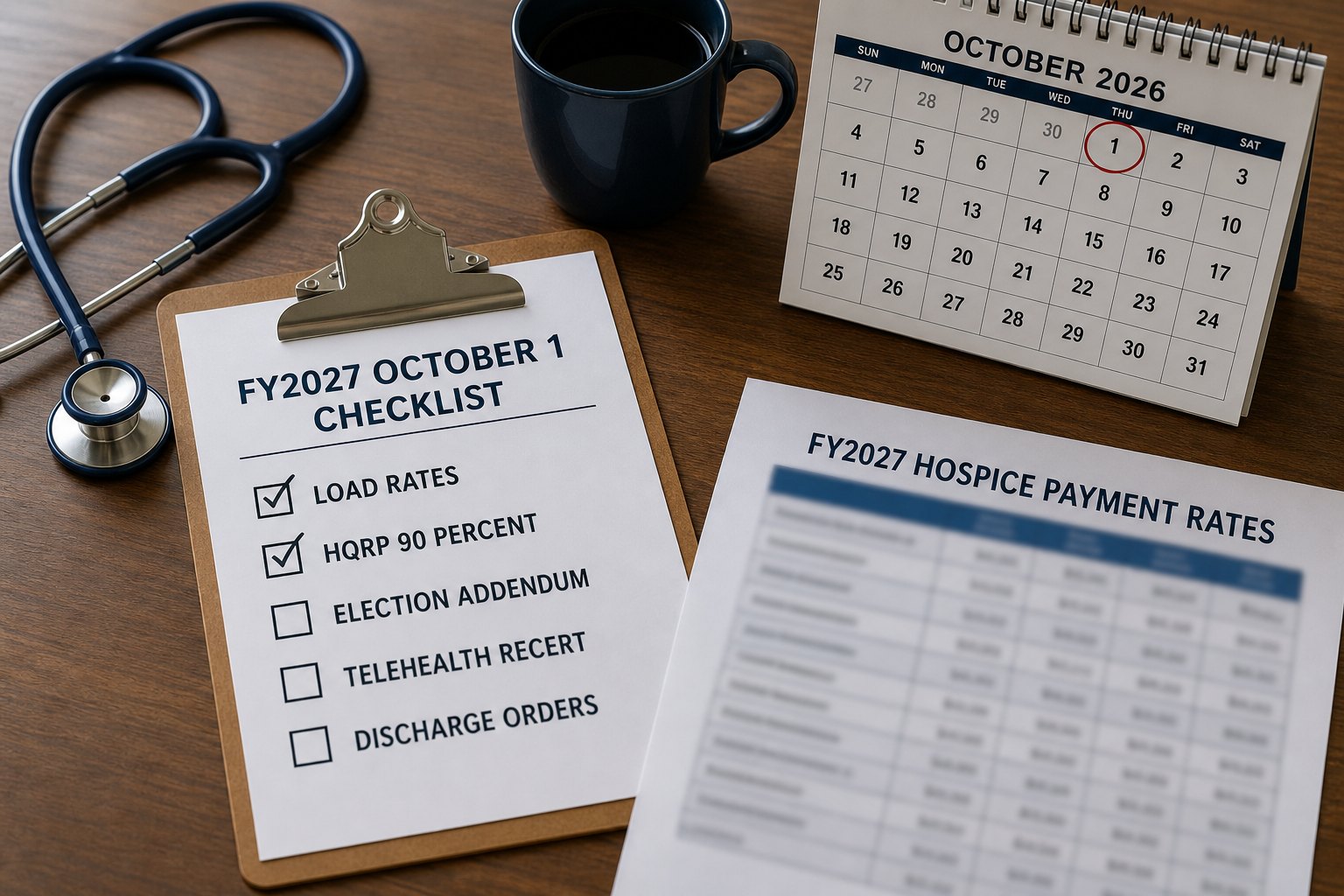
October 1, 2026 is five weeks from today. The FY2027 hospice final rule is no longer a proposal. CMS-1851-F went on public inspection July 30, 2026, published at 91 FR 49118 on August 3, 2026, and it is effective October 1, 2026. This is not another SSVI explainer and it is not a recap of the proposed rule. It is the operator list: the rates to load, the form every Medicare admission now needs, the quality clock that will show up on Care Compare, the telehealth recert you can still use, and who can sign a discharge when the medical director is not in the building.
CDPH Emergency Regulation Changes — Live Q&A This Wednesday at 10:00 AM Pacific
Wednesday, October 14 · 40 minutes · Hosted by Miles Pickens, Hospice Engine
Bring your questions on CDPH’s emergency hospice licensing regulations (Title 22) — nurse ratios, management qualifications, CHOW, and the licensing moratorium. Zoom link sent by email when you register. The first 3 seats each Wednesday session are free.
The Money: 2.3% — or a 1.7% Cut If You Miss HQRP
CMS finalized a 2.3% hospice payment update for FY2027: a 3.2% market basket increase minus a 0.9 percentage-point productivity adjustment. The agency estimates that is about $755 million more than FY2026. That is the headline. It is not the rate you will be paid if you miss Hospice Quality Reporting Program requirements.
Fail HQRP and the same 2.3% is reduced by 4 percentage points. That is a −1.7% update versus the prior year — a cut, not a raise. The 4-point APU reduction has been in effect since FY2024. It is not new policy. It is a rate you can still lose. CMS’s own non-compliance figures: 22.06% of hospices in FY2024, 23.53% in FY2025, 20.37% in FY2026. About one hospice in five missed it in FY2026.
The FY2027 hospice cap is $36,174.75 (the FY2026 cap of $35,361.44 × 1.023). Load it next to the per-diems. The cap is the number that quietly ends the year for long-stay census, and it moves on October 1 with everything else.
National unadjusted FY2027 rates, with last year’s figures and the no-quality-data rates beside them. The wage index still applies. These are not CBSA-specific rates — do not paste them into a claim without your CBSA factor.
| Level of care | FY2026 | FY2027 | FY2027, no quality data |
|---|---|---|---|
| RHC, days 1–60 | $230.83 | $236.35 | $227.11 |
| RHC, days 61+ | $181.94 | $186.35 | $179.06 |
| CHC, full 24 hours | $1,674.29 | $1,726.50 | $1,658.99 |
| CHC, hourly | $69.76 | $71.94 | —1 |
| IRC | $532.48 | $545.98 | $524.63 |
| GIP | $1,199.86 | $1,231.63 | $1,183.47 |
The operational control for the 4-point cut is the same one it has been: 90% of HOPE/HIS records accepted within 30 days of admission, HUV, and discharge. FY2027 APU uses HIS/HOPE for admissions and discharges from January 1, 2025 through December 31, 2025, plus monthly CAHPS through 2025. CMS granted a waiver: all HOPE assessments dated October 1, 2025 through December 31, 2025 (target date in 2025) are considered timely. That window is closed. You cannot go back and fix FY2027 APU with a September sprint. What you can still control is FY2028.
The Public Badge: What You Submit This Fall Is What Families Will See
FY2028 APU uses 90% of HOPE records for January 1, 2026 through December 31, 2026 — including HUV completion dates — plus CAHPS for 2026. That year is in progress. Every late HOPE this fall is a FY2028 APU problem, not a documentation nuisance.
CMS also finalized a Care Compare icon for hospices that fail to submit any quality data or submit under 90%. It is effective no earlier than FY2028, based on calendar year 2026 data. Families will see it. The work on your 30-day HOPE dashboard this quarter is the work that either puts that icon on your public profile or keeps it off. Treat the quality file the way you already treat a claim: accepted, on time, or it did not happen.
The Form Every Admission Now Needs
The election statement addendum is mandatory for all Medicare hospice elections beginning on or after October 1, 2026 — not upon request. That is 42 CFR § 418.24(b)(6), (c), and (d). Furnish it in writing within the first 5 days of the election effective date. Update it within 3 days if a plan-of-care change affects the determinations. File it with the election statement for the patient, non-hospice providers, and Medicare contractors. The election statement itself must say the addendum will be provided. CMS’s March 2024 model election statement still says patients have a “right to request” it; that language is stale for October 1 elections, and so is any template copied from it. The March 2024 model addendum is still the content skeleton — the trigger is what changed. We published the filled-in sample and the ADR packet path in the companion piece: The FY2027 Election Addendum Is Now Law. Use that post for the form. Use this one to put the 5-day clock on this week’s intake list.
SSVI Is Finalized. Look Up Your Score and Move On.
The Service and Spending Variation Index was finalized as proposed. No methodology change. Nine claims-based measures, with FY2024 and FY2025 data already in the rule. CMS reported more than $2.8 billion in Parts A, B, and D spending during hospice elections in FY2024 — the non-hospice-spending context sitting underneath both SSVI and the mandatory addendum. If you have not pulled your score, use the free SSVI lookup. If you need the construction, start at the SSVI overview. This post is not an SSVI explainer. The October 1 work is rates, HQRP, the addendum, telehealth coding, and discharge orders.
Telehealth Recert Stays Through 2027. Code It Starting January 1, 2027.
As finalized at 42 CFR § 418.22(a)(4)(ii), recertification face-to-face via telecommunications — audio and video, real-time two-way — is allowed through December 31, 2027 (or a public health emergency if later). It is an administrative expense, not a visit. Do not bill it as one.
For face-to-face encounters on or after January 1, 2027, hospices must report telehealth face-to-face on the claim per CMS guidance. CMS will issue the G-code and the instructions before that date. Do not guess a code number and do not hard-code a placeholder in production. When CMS issues the G-code, map it, test a claim, and brief the medical director.
The integrity exceptions have been in effect since January 31, 2026. Telehealth may not be used for the recertification face-to-face if: (A) the patient is in an area subject to a hospice enrollment moratorium under SSA § 1866(j)(7); (B) the hospice is under enhanced oversight under § 1866(j)(3); or (C) the physician or nurse practitioner conducting the encounter is not Medicare-enrolled and is not an opt-out physician or practitioner. CMS has separately clarified, in its home health and hospice moratorium FAQs, that hospices already enrolled in Medicare can continue to use telehealth for recertification face-to-face and are not impacted by the nationwide enrollment freeze. If you are an existing operator, the May 13 freeze did not take this tool away. Do not pull telehealth recert because someone forwarded the moratorium headline.
Who Can Sign a Discharge
42 CFR § 418.26(b) now lets the written physician discharge order come from the hospice medical director, or the physician designee (defined at § 418.3), or a physician member of the interdisciplinary group. Consult the attending physician if the patient has one, and put that review in the discharge note.
The operational point is weekends and small shops. You can move a legitimate discharge without waiting on one person. It is still a physician order. It is not an RN discharge. Update the policy, name the designee in writing, and tell the on-call physician IDG members they are authorized — before the Saturday night when the current medical director is unreachable and the family is at the bedside.
Calendar Item: The May 13 Freeze Is Still Running
The nationwide hospice enrollment moratorium began May 13, 2026, runs six months (roughly mid-November), and CMS can extend it. Existing operators keep billing. We covered the mechanics in the May moratorium post. It is on this list only so it does not surprise anyone in a staff meeting. Do not rebuild your enrollment file around it this week. Rebuild the October 1 file.
This Week’s Punch List
Five weeks is enough time if someone owns each line. It is not enough time if this sits in a shared inbox until September 30.
- Billing lead — load the FY2027 rates. National unadjusted per-diems and the $36,174.75 cap in the billing system by October 1. Confirm the CBSA wage-index crosswalk. Confirm the no-quality-data schedule exists as a switch you hope never to flip. Test one RHC, one GIP, and one CHC claim before a live patient bills at the new rates.
- QAPI / quality — stand up a 90% HOPE dashboard. Records accepted within 30 days of admission, HUV, and discharge. FY2027 APU is already tied to CY2025. FY2028 APU, and the Compare icon, are tied to CY2026 including HUV. This fall is the year families will see. Assign a named owner to every HOPE still inside the 30-day acceptance window.
- Compliance / admissions — rewrite the election statement and addendum templates. Strike “right to request.” Insert “will be provided.” Build the 5-day furnish clock and the 3-day update clock into intake, not into a binder. The filled-in sample and the ADR packet path are in the companion addendum post. Use that packet; do not draft a parallel form.
- Clinical leadership / IDG — relatedness at intake. The addendum is downstream of a real relatedness determination. Make the IDG/physician call a required, documented step on every Medicare election so the form writes from a decision, not from boilerplate. That is also how you keep the addendum from contradicting the plan of care, the certification, and the non-hospice claims file.
- Medical director + DPCS — rewrite the discharge-order policy. Name the physician designee under § 418.3. Confirm which physician IDG members may sign. Script the attending consult and the discharge-note language. Walk it with on-call before the first weekend in October.
- Billing + medical director — telehealth recert plan. Keep using real-time audio-and-video recert through December 31, 2027. When CMS issues the G-code, map it for encounters on or after January 1, 2027. Brief the three integrity exceptions. Do not shut off telehealth recert because of the May 13 freeze.
- Administrator — look up your SSVI. Pull the score, hand the outlier measures to QAPI, and get back to the October 1 list. The methodology did not change in the final rule. Dwelling on it this week is how the addendum and the rate file slip.
Documentation & Compliance Consulting: $300/hour
We can load the FY2027 rates, rewrite your election statement and addendum templates, stand up the relatedness determination at intake, and walk the discharge-order and telehealth-recert policies with your medical director — so October 1 is a go-live, not a scramble.
Schedule a ConsultationFurther Reading
- The FY2027 Election Addendum Is Now Law — filled-in sample and the ADR packet path
- The Election Statement Addendum Is About to Become Mandatory for Every Patient — what we wrote when this was still the proposed rule
- CMS Built a New Score That Flags Your Hospice for Oversight: Meet the SSVI
- Decoding Your SSVI Score, Part 1: Non-Hospice Spending
- Now Live: A Free Tool to Look Up Your Hospice’s SSVI Score
- CMS Just Froze New Hospice Enrollments Nationwide
- Got a Qlarant “Notice of Suspension”? The 15-Business-Day Rebuttal Playbook
- Meet Hospice Engine: The EMR and Billing Team Built Only for Hospice
- CMS Fact Sheet — FY2027 Hospice Wage Index Final Rule (CMS-1851-F)
- Federal Register — FY2027 Hospice Final Rule (91 FR 49118, August 3, 2026)
The Bottom Line
October 1 is a rate file, a form, a 30-day quality clock, a telehealth coding date in 2027, and a discharge-order policy that no longer bottlenecks on one physician. The final rule is already in the Federal Register. Five weeks is enough if the seven lines above have names on them this week. It is not enough if you wait for a CMS transmittal to make the addendum feel real. Load the rates. Rewrite the election language. Put relatedness on every intake. Keep telehealth recert. Name who can discharge on a Saturday. Then go back to taking care of patients.