
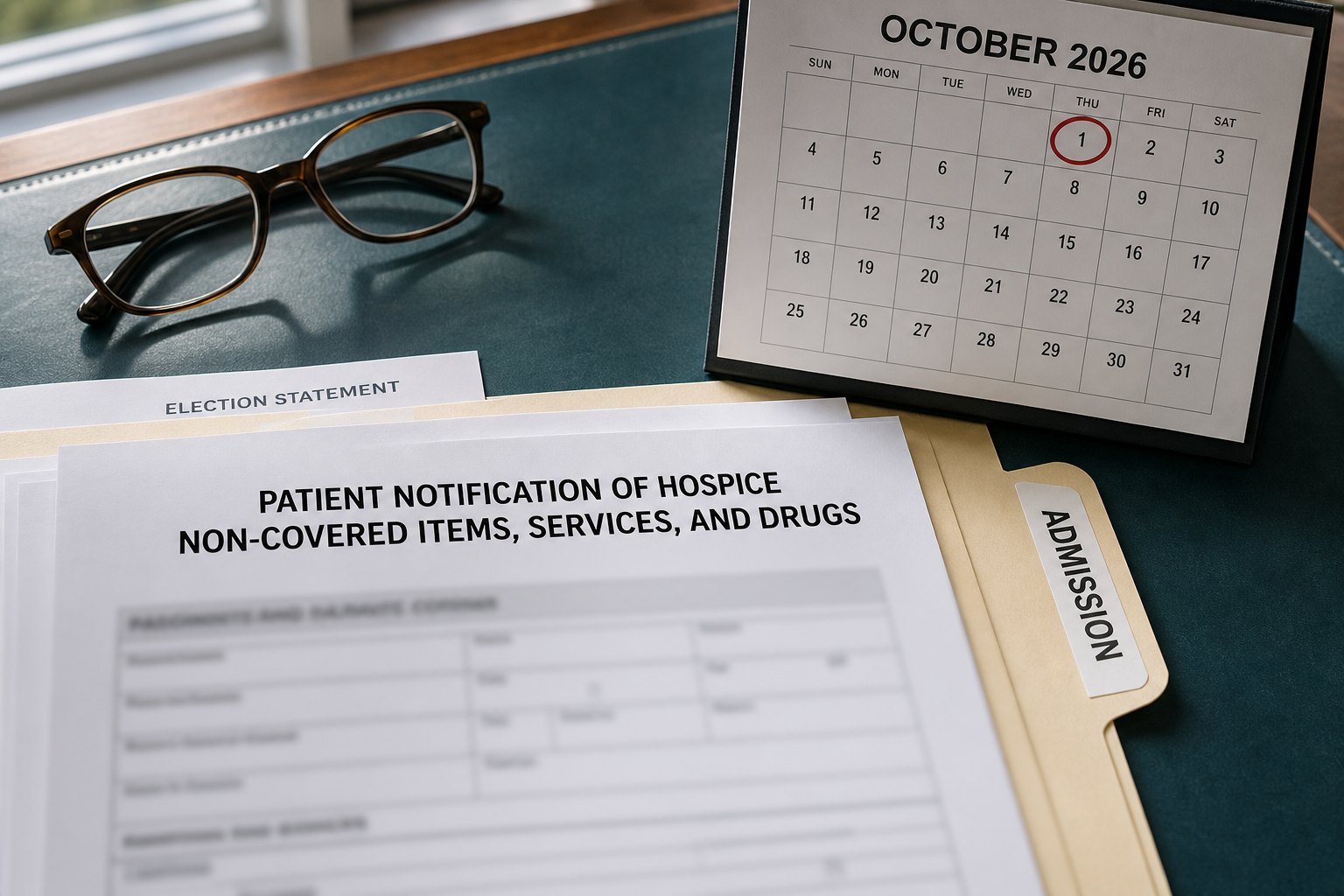
The May 26 proposed-rule post was the proposal chapter. That chapter is closed. The FY 2027 Hospice Wage Index and Payment Rate Update final rule — CMS-1851-F — posted for public inspection on July 30, 2026, published in the Federal Register on August 3, 2026 at 91 FR 49118, and is effective October 1, 2026. That is five weeks from today.
For hospice elections beginning on or after October 1, 2026, 42 CFR 418.24(b)(6) requires the hospice to provide the individual (or representative) an election statement addendum. Not if they ask. Every Medicare election. The 5-day clock starts at the election effective date, not at a request. Plan-of-care changes that hit the addendum determinations get a written update inside 3 days. This post is the operator follow-up: what actually finalized, what the March 2024 CMS model still gets wrong, a filled-in example using the model field order, and how to put the addendum in an ADR packet so a reviewer can find it.
CDPH Emergency Regulation Changes — Live Q&A This Wednesday at 10:00 AM Pacific
Wednesday, October 14 · 40 minutes · Hosted by Miles Pickens, Hospice Engine
Bring your questions on CDPH’s emergency hospice licensing regulations (Title 22) — nurse ratios, management qualifications, CHOW, and the licensing moratorium. Zoom link sent by email when you register. The first 3 seats each Wednesday session are free.
What Changed in the Final Rule
The addendum itself is not new. The FY2020 final rule (84 FR 38484) created it and made it furnish-upon-request. Formal title: Patient Notification of Hospice Non-Covered Items, Services, and Drugs. It is the written list of conditions, items, services, and drugs the hospice has determined to be unrelated to the terminal illness and related conditions, and therefore not covered under the hospice benefit.
What CMS-1851-F flips is the trigger, the clock, and the election-statement language. Side by side:
- Who gets one. Before October 1: only if the beneficiary, representative, a non-hospice provider, or a Medicare contractor requests it. On or after October 1: every Medicare election. 42 CFR 418.24(b)(6) is mandatory-at-election language, not request language.
- When the 5-day clock starts. Before: 5 days from the request if asked at election, and 3 days from the request if asked later in the stay. After: provide it in writing at the time of election, that is, within the first 5 days of the effective date of the hospice election (418.24(d)(1)). No one has to ask for the clock to run.
- Updates. If plan-of-care changes during care impact the addendum determinations, update the addendum within 3 days with the 418.24(c) contents, provide it in writing, and update the file (418.24(d)(2)). The 3-day clock is now tied to a POC change that changes the relatedness call, not to a mid-stay request.
- What the election statement itself has to say. The CMS model election statement still has a “Right to Request” the addendum. After October 1 that sentence is wrong. (b)(6) requires the addendum to be provided. The election statement has to say it will be provided, not that the patient may request it. You update both forms.
The upon-request rule does not vanish for people already on service. Elections that began before October 1 still follow the old request clocks. Do not mix the two populations in the same chart audit, and do not mix them in the same ADR packet.
Why CMS Did It
CMS’s fact sheet on CMS-1851-F is not subtle: non-hospice spending on hospice-enrolled beneficiaries grew substantially from FY 2020 through FY 2024, especially Part A and Part B. CHAP’s summary of the final rule, quoting CMS, puts numbers on that sentence. Total non-hospice spending exceeded $2.8 billion in FY 2024. Part A/B rose from about $790 million in FY 2020 to more than $2.0 billion in FY 2024. Part D went from $552,953,466 (FY 2020) to $813,107,802 (FY 2024).
CMS’s read of those years: the upon-request addendum did not produce the accountability it was written for, because many beneficiaries never ask. So the default flips. One sentence on the scoreboard, and then we are done with it: the SSVI is how CMS scores the non-hospice spending this form is supposed to explain. The mechanics are in Decoding SSVI, Part 1. This post is about the form you now have to put in every chart.
What Has to Be on the Form
Start from CMS’s March 2024 model addendum PDF. Map 42 CFR 418.24(c) onto those fields. This is the required-content list, in model order:
- Title. Model: “Patient Notification of Hospice Non-Covered Items, Services, and Drugs.”
- Name of the hospice. Model: Hospice Agency Name.
- Individual’s name and hospice medical record identifier. Model: Patient Name, Patient MRN.
- Identification of the individual’s terminal illness and related conditions. Model: Diagnoses Related to Terminal Illness and Related Conditions (8 numbered slots).
- List of conditions present and associated items, services, and drugs not covered because unrelated. Model: Diagnoses Unrelated to Terminal Illness and Related Conditions (8 slots), plus the table Items/Services/Drugs | Reason for Non-coverage.
- Written clinical explanation in language the individual can understand, plus the general statement that relatedness is decided per patient and they should share the list with other providers. Model: the Reason for Non-coverage column and the note under the table.
- References to any relevant clinical practice, policy, or coverage guidelines. Put them in the reason text. The sample below uses Medicare Benefit Policy Manual, Chapter 9.
- Purpose; right to immediate advocacy; hospice / BFCC-QIO / Medicare contact info. Model: Purpose of Issuing this Notification, Right to Immediate Advocacy, https://qioprogram.org/locate-your-qio or 1-800-MEDICARE (1-800-633-4227), TTY 1-877-486-2048. Rewrite the purpose paragraph — the March 2024 version is still request-clock language. See below.
- Signature, date signed, and the receipt-not-agreement statement, plus refusal-to-sign documentation. Model: Signature of Beneficiary; Signature of Beneficiary Representative if unable to sign; Date Signed; and the sentence that signing is only acknowledgement of receipt and does not constitute agreement with the hospice’s determinations. If the individual refuses to sign, document the reason on the addendum; it still becomes part of the medical record. Non-hospice providers and Medicare contractors may use the addendum; they are not required to sign (418.24(c)(9)).
- Date furnished (418.24(c)(10)). Model: Date Furnished. CMS’s own note: this is when the beneficiary (or representative) receives the addendum, not the signature date.
What an Addendum Actually Looks Like
CMS has not posted a post-final-rule model. The hospice fee-for-service downloads page at cms.gov/medicare/payment/fee-for-service-providers/hospice was last modified July 2, 2026 — before public inspection of CMS-1851-F. The live PDFs are still the March 2024 models:
- Model Hospice Election Statement Addendum (March 2024)
- Model Example of the Hospice Election Statement (March 2024)
Start from those PDFs. Then rewrite the request language before you print another copy. Two stale blocks will fail a October 1 chart:
- Addendum purpose paragraph. The March 2024 PDF still says the purpose is to notify the requesting beneficiary, and it still runs the old clocks: furnish within 5 days of the request if asked in the first 5 days of election, within 3 days of the request if asked later. That paragraph is wrong for elections on or after October 1. Rewrite it to say the addendum will be provided at election, within the first 5 days of the effective date, with a 3-day update when a plan-of-care change impacts the determinations.
- Election statement “Right to Request.” After October 1 that heading is wrong. (b)(6) is a provide-it duty. Operators update both forms.
The Date Furnished note on the model is stale in the same way: it still defines the date as receipt “within 3 or 5 days from their request.” Keep the useful half — date furnished is receipt, not signature — and drop the request trigger.
Here is a filled-in EXAMPLE in CMS model field order. It is not a real patient, not an official CMS form, and not legal advice. Copy the field order. Do not copy the clinical calls onto a live chart.
Patient Notification of Hospice Non-Covered Items, Services, and Drugs
Operator-updated purpose language for elections on or after October 1, 2026
Patient Name: Jane R. Patient MRN: 10482
Hospice Agency Name: Example Hospice of Central Texas Date Furnished: October 4, 2026
Election effective date: October 2, 2026 · Date furnished is day 2 of the 5-day window · not a model field, shown here so the clock is visible
Purpose of Issuing this Notification
The purpose of this addendum is to notify you, in writing, of those conditions, items, services, and drugs not covered by the hospice because the hospice has determined they are unrelated to your terminal illness and related conditions. For hospice elections beginning on or after October 1, 2026, the hospice must provide this addendum at the time of election, within the first 5 days of the effective date of the hospice election. If the plan of care later changes in a way that affects these determinations, the hospice must update this addendum and provide the update in writing within 3 days.
Diagnoses Related to Terminal Illness and Related Conditions
- Metastatic non-small cell lung cancer (terminal illness)
- COPD
- Protein-calorie malnutrition
- Anxiety
- Opioid-induced constipation
- —
- —
- —
Diagnoses Unrelated to Terminal Illness and Related Conditions
- Primary open-angle glaucoma (longstanding, ophthalmology-managed)
- Well-controlled hypothyroidism
- —
- —
- —
- —
- —
- —
Items, Services, and Drugs Determined by Hospice to be Unrelated to Your Terminal Illness and Related Conditions (these items, services, and drugs will not be covered under the hospice benefit)
| Items/Services/Drugs | Reason for Non-coverage |
|---|---|
| Latanoprost 0.005% ophthalmic solution, one drop in the affected eye nightly | Jane has used this eye drop for years to treat glaucoma. It lowers eye pressure. It does not treat her lung cancer, her breathing, her pain, or her other hospice-related conditions. The hospice will not cover it. She should keep getting it from her eye doctor; it can continue under Medicare Part D. Coverage reference: Medicare Benefit Policy Manual, Chapter 9 (hospice covers items related to the terminal illness and related conditions; unrelated items remain payable under other Medicare benefits). |
| Levothyroxine 75 mcg by mouth daily | Jane has taken this thyroid replacement every day for eight years. Her thyroid condition is stable and is not caused by her lung cancer or her lung disease. The hospice will not cover this tablet. It continues as her regular Medicare Part D medication. Coverage reference: Medicare Benefit Policy Manual, Chapter 9 (hospice covers items related to the terminal illness and related conditions; unrelated items remain payable under other Medicare benefits). |
Note: The hospice makes the decision as to whether conditions, items, services, and drugs are related for each patient. As the beneficiary (or beneficiary representative), you should share this list and clinical explanation with other healthcare providers from which you seek items, services, or drugs unrelated to your terminal illness and related conditions to assist in making treatment decisions. The hospice should provide its reasons for non-coverage in language that you (or your representative) understand.
Right to Immediate Advocacy
As a Medicare beneficiary, you have the right to contact the Medicare Beneficiary and Family Centered Care-Quality Improvement Organization (BFCC-QIO) for Immediate Advocacy if you (or your representative) disagree with the hospice’s decision on items not covered because the hospice has determined they are unrelated to your terminal illness and related conditions. Locate the BFCC-QIO for your area: https://qioprogram.org/locate-your-qio or call 1-800-MEDICARE (1-800-633-4227). TTY: 1-877-486-2048. [BFCC-QIO for this patient: list the QIO that serves the patient’s state.]
Note: Date furnished is the date the beneficiary (or representative) receives the addendum, not the date of the signature. Date furnished on this example: October 4, 2026.
Signing this notification (or its updates) is only acknowledgement of receipt of this notification (or its updates) and does not constitute your agreement with the hospice’s determinations.
Signature of Beneficiary: Jane R.
Signature of Beneficiary Representative (if beneficiary is unable to sign): —
Date Signed: October 4, 2026
You still furnish the addendum when nothing is unrelated. 418.24(b)(6) is every election, not every election with an unrelated item. CMS did not write an out for a blank form. Same demographics, same related diagnoses, and then:
Same example patient — none-unrelated variant
Diagnoses Unrelated to Terminal Illness and Related Conditions: None identified at this time.
Items/Services/Drugs | Reason for Non-coverage: None identified at this time.
Clinical note: At election, Jane’s current conditions and medications are related to the terminal prognosis of metastatic non-small cell lung cancer and its related conditions. The hospice is covering them under the hospice benefit. This addendum is still furnished because 42 CFR 418.24(b)(6) requires it for every election on or after October 1, 2026.
How the Clocks Work
Write these on the admissions whiteboard. They are not the old request clocks.
- 5-day election clock — 418.24(d)(1). Provide the addendum in writing at the time of hospice election, that is, within the first 5 days of the effective date of the hospice election. File it with the election statement so it is available to the individual, non-hospice providers, and Medicare contractors. In the example above, election effective October 2, 2026, furnished October 4, 2026 — inside the window, not on the last day.
- 3-day update clock — 418.24(d)(2). If plan-of-care changes during care impact the addendum determinations, update the addendum within 3 days with the (c) contents, provide the update in writing to the individual (or representative), and update the file. No POC impact on the unrelated list means no update. A new unrelated drug, a relatedness flip, or a condition that just entered the picture means the 3-day clock is running.
- Date furnished vs. date signed — 418.24(c)(9) and (c)(10). Date furnished is receipt. Date signed is the acknowledgement. They can be the same day. They are not the same field. Capture both.
- Death, revocation, or discharge before you furnish it — 418.24(d)(3). If the individual dies, revokes, or is discharged within the required timeframe before the hospice has provided the addendum (and its updates), the written addendum is not required to be provided to the individual. Note the reason it was not completed or provided; that note is part of the medical record. If you completed it anyway, still file it with the election statement.
- Death, revocation, or discharge before they sign — 418.24(d)(4). The addendum is not required to be signed in order for the hospice to receive payment. Note the reason on the addendum itself.
- Refusal to sign — 418.24(c)(9). Document the reason on the addendum. It still becomes part of the medical record. Signing is only acknowledgement of receipt, not agreement with the determinations.
Do not read that as “every missing addendum is an automatic claim denial.” CMS did not write that sentence. What it did write, at 418.24(d)(4), is payment language about the signature: die / revoke / discharge before signing, and the signature is not required for payment. The exception is the tell. Outside that window, the signature is a payment issue. And on medical review, the CGS hospice ADR checklist already lists the signed election statement and addendum(s) immediately after the ADR cover. For elections on or after October 1, 2026, reviewers will expect the addendum in every chart — not only “if requested.”
How a Form Becomes Evidence
Once the addendum is in every chart, it is a relatedness statement you signed your name to. Reviewers will read it against the rest of the record. Three failure modes, none of them theoretical:
- Contradiction. The addendum lists a condition as unrelated, and the certification, plan of care, or IDG notes treat it as part of the terminal picture. That is an internal conflict in writing. Relatedness is a patient-specific hospice determination — make it once, then make the chart agree with itself.
- Gap against claims. Part B or Part D claims exist for items you never listed as unrelated. That mismatch is exactly what the non-hospice spending growth — and the SSVI — is built to surface. Either the item belonged on the addendum, or it belonged on the hospice benefit. A silent third option does not survive review.
- Missing or unusable signature trail. No date furnished. Signature date used as a stand-in for receipt. No refusal-to-sign note. No (d)(3) or (d)(4) note when the patient died inside the window. The form is in the EMR template library and not in the chart. For a post-October 1 election, that is a binary finding: it is there, complete, and findable, or it is not.
Boilerplate that lists nothing specific, or a “none unrelated” addendum with no clinical note and related diagnoses left blank, is not a defense. It reads as if the determination never happened.
If You Get an ADR: How to Put the Addendum in the Packet
This is the production version, not the policy version. You have an Additional Documentation Request. The addendum is now a document the reviewer will look for on every post-October 1 election, in a fixed place in the packet.
The deadline on the letter
Prepayment review: 45 calendar days from the request (42 CFR 405.903). If the records are not received, the claim is typically denied. MACs, SMRC, and RAC may accept late documentation for good cause. UPIC windows can be shorter. Follow the letter in your hand, not a blog post, if the two disagree.
Cover sheet, then the election packet
Put the ADR letter or a FISS Page 07 screen print on top of each claim’s packet so the DCN and the claim match. Include a contact form or cover with PTAN, NPI, and a phone number. Do not mix claims in one blob.
CGS Home Health & Hospice medical-review ADR preferred order (from the CGS ADR QRT):
- ADR letter (or FISS Page 07) and Contact Form
- Signed election statement + Addendum(s)
- Plan of care with physician certification / recertifications
- Physician Face-to-Face (third and later benefit periods)
- Physician orders
Then IDG reviews, assessments, visit notes, and the rest of the chart. Technical denials happen when reviewers cannot find the election and addendum. Place them immediately after the ADR cover. Do not bury them behind the visit notes.
How to send it
Use the method named on that letter: esMD (include the DCN), MAC portal (myCGS, Noridian Medicare Portal, or whichever portal the letter names), fax, mail, or password-protected CD. One claim, one packet. Keep a copy of what you submitted — portal receipt, esMD acknowledgement, fax confirmation.
What “providing the addendum” means for elections on or after October 1, 2026
- Send the patient-specific signed copy, not a blank template and not a policy.
- Include Date Furnished (receipt date, not signature date).
- Include every update (the 3-day POC-change versions), in date order.
- If the patient refused to sign: send the addendum with the documented reason; it is still part of the record.
- If the patient died, revoked, or was discharged inside the 5-day (or 3-day update) window before you furnished it: send the chart note required by (d)(3), and the completed addendum if you finished it anyway.
- If they died, revoked, or were discharged before signing: (d)(4) — not required to be signed for payment; send the unsigned addendum with the reason noted on the form.
- Cross-check before you hit send. Unrelated items on the addendum should not contradict the certification, plan of care, and IDG notes. If Part B or Part D claims exist for items you never listed as unrelated, explain or fix the record before the packet goes out. That mismatch is the non-hospice-spending problem this rule was written to expose.
Pre-October 1 elections still follow the old upon-request rule: the addendum is “as applicable” if it was requested. Label the two populations. A reviewer looking at a September 28 election and an October 2 election in the same ADR should not have to guess which rule you think applied.
What to Do This Week
Today is Tuesday, August 25, 2026. October 1 is five weeks out. This is not a 2027 project. It is this month’s admissions rebuild.
- Inventory both templates today. Pull the election statement and the addendum. Confirm they still match the March 2024 CMS field list. Find out who on staff has actually completed an addendum in the last twelve months. Most hospices have a form they almost never use. That era ends on October 1.
- Rewrite the request language this week. On the addendum, replace “requesting” and the 5-day / 3-day request clocks with will-be-provided language and the election-date clocks. On the election statement, replace “Right to Request” with a statement that the addendum will be provided. CMS has not shipped a new model. You still have to fix yours.
- Make IDG relatedness a required intake step. The form is downstream of the clinical call. The admitting RN and the IDG / physician decide, on the record, which conditions, items, services, and drugs are unrelated. A clerk cannot invent that list at the end of the admission so the chart can close.
- Make the EMR generate it, capture both dates, and store updates. Date furnished and date signed are separate fields. Refusal-to-sign and (d)(3)/(d)(4) notes have to live on the form, not in a stray progress note nobody will find during an ADR. Updates are new versions, in date order, not overwritten rows.
- Build the 3-day update path. When a plan-of-care change hits relatedness, who notices, who revises the addendum, who delivers it, and where the updated file lives for non-hospice providers and Medicare contractors. If that path is “someone will remember,” it will fail the first busy weekend in October.
- Reconcile against non-hospice claims. Pull a sample of current patients with Part B or Part D activity. Ask, for each item, whether it would be on the addendum. Gaps you find in August are fixable. Gaps a reviewer finds in an ADR packet are the case.
- Train admissions on the exceptions this week, not in late September. Refusal to sign. Death, revocation, or discharge inside the 5-day window. Signature vs. receipt. “None unrelated” still gets a form. Two populations in one ADR. Put the CGS order on the wall next to the fax / portal instructions.
Documentation & Compliance Consulting: $300/hour
We review election-statement and addendum templates against finalized 42 CFR 418.24, rewrite the stale March 2024 request language, build the relatedness determination into intake, and walk an ADR packet so the signed addendum is where the reviewer will look. Five weeks is enough if the forms move this week.
Schedule a ConsultationFurther Reading
- October 1 Is Five Weeks Out: The FY2027 Final-Rule Checklist
- May 26, 2026 — The proposal chapter: the addendum becomes mandatory (CMS-1851-P)
- CMS Built a New Score That Flags Your Hospice for Oversight: Meet the SSVI
- Decoding SSVI, Part 1: Non-Hospice Spending
- CMS Fact Sheet — FY 2027 Hospice Wage Index and Payment Rate Update (CMS-1851-F)
- Federal Register — CMS-1851-F (91 FR 49118, August 3, 2026)
- CMS Model Hospice Election Statement Addendum (March 2024 PDF)
- CMS Model Example of the Hospice Election Statement (March 2024 PDF)
- CMS Hospice Center — fee-for-service downloads (page last modified July 2, 2026)
The Bottom Line
CMS-1851-F is law. Effective October 1, 2026 — five weeks from today — every Medicare hospice election gets an election statement addendum, furnished in writing within the first 5 days of the election effective date, updated within 3 days when a plan-of-care change hits the determinations, signed as acknowledgement of receipt only, with Date Furnished captured as the receipt date. The March 2024 CMS models are still the starting PDFs, and both still talk like the upon-request rule. Rewrite them. Make relatedness an intake decision, not a clerical afterthought. When an ADR lands, the patient-specific addendum — and every update — goes immediately after the cover letter, not behind the visit notes. Treat the form as the relatedness record it is, and it defends the chart. Treat it as a blank to generate at discharge, and you have written the finding for the reviewer.