
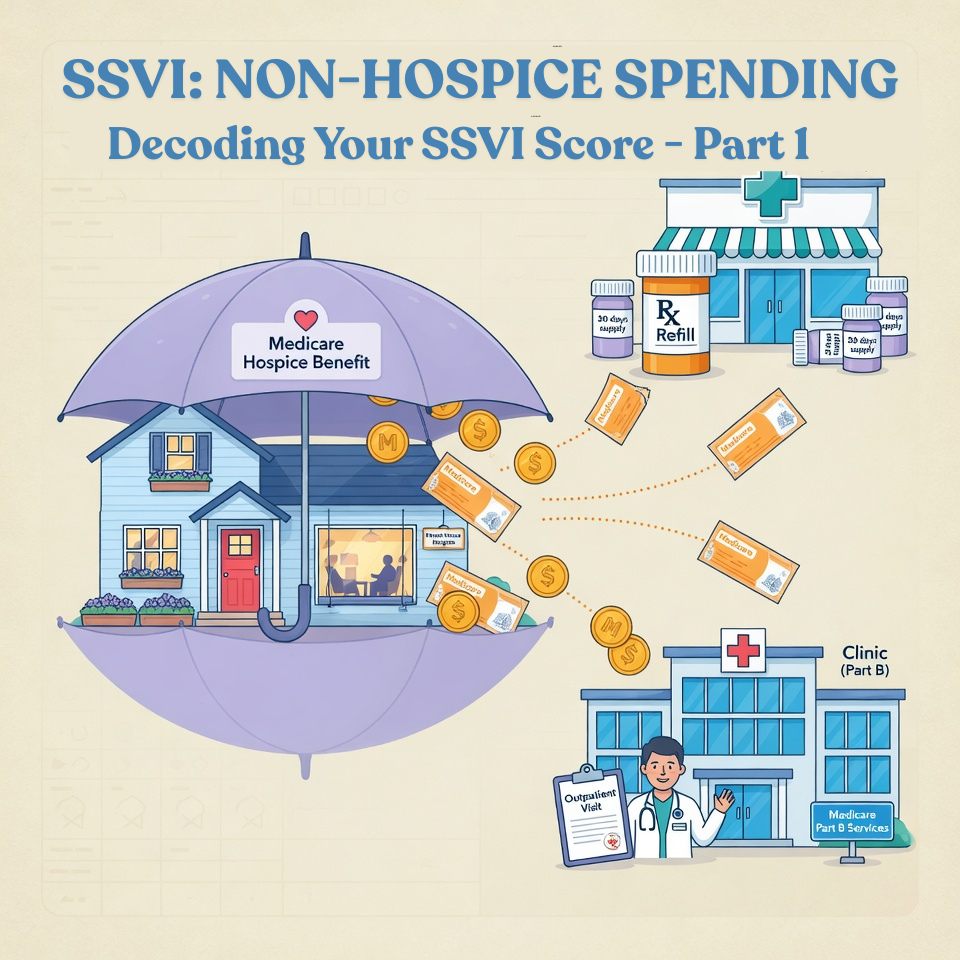
This is Part 1 of Decoding Your SSVI Score — a series where we take CMS’s new hospice score apart, one component at a time, and explain in plain English what each piece measures and what you can actually do to improve it. We’re starting with the half of the score most operators understand the least: non-hospice spending.
If your hospice’s SSVI score came back higher than you expected, there’s a good chance this is why. The Non-Hospice Spending Score is worth up to 8 of the 16 total SSVI points — and unlike the utilization measures, it’s driven by dollars Medicare spent on your patients that you may not even know about. Here’s exactly what it is, how the points are assigned (with the real FY2025 dollar thresholds), and what you can do to bring it down.
New to the SSVI? Start with our overview, CMS Built a New Score That Flags Your Hospice for Oversight, and look up your own score free. The SSVI runs 0–16 and is the sum of two halves: the Non-Hospice Spending Score (0–8) and the Utilization Score (0–8). This post is about the first half.
What “Non-Hospice Spending” Actually Means
When a beneficiary elects hospice, the hospice agrees to manage and pay for essentially everything related to the terminal prognosis out of its daily per-diem payment. In exchange, the beneficiary waives Medicare’s payment for those related services. So in a well-run election, Medicare should see very little spending on that patient outside the hospice.
Non-hospice spending is what Medicare paid anyway. Specifically, the SSVI counts:
- Fee-for-service Part A and Part B claims for your hospice patients during their election — hospital and facility services, physician and outpatient services, procedures, DME, and the like.
- Part D prescription drug events — medications filled under the patient’s drug plan while they were on your service.
CMS builds the score from FY2024 and FY2025 claims. Some of this spending is legitimate — care for a condition genuinely unrelated to the terminal prognosis, or the small set of carve-outs Medicare allows (for example, an attending physician who isn’t employed by the hospice). But much of it traces back to one place: items and services that should have been covered under your per-diem, billed elsewhere instead. That’s the signal CMS is reading.
How the 0–8 Score Is Assigned
The mechanics are simple:
- If your hospice reported no non-hospice spending, you get 0 points for this component.
- Every other hospice is sorted by total non-hospice spending and split into eight roughly equal groups — the lowest-spending eighth gets 1 point, the highest-spending eighth gets 8.
Because the groups are set by where all hospices land, the dollar cut points move each year. Here are the actual FY2025 thresholds from CMS’s SSVI methodology file:
| Points | Total non-hospice spending (FY2025) |
|---|---|
| 0 | None reported |
| 1 | Up to $6,352.84 |
| 2 | Up to $20,612.10 |
| 3 | Up to $42,911.79 |
| 4 | Up to $76,801.05 |
| 5 | Up to $133,440.80 |
| 6 | Up to $246,123.06 |
| 7 | Up to $517,204.41 |
| 8 | Above $517,204.41 |
These are FY2025 figures from the CMS SSVI overview document; the FY2024 top group started above $520,100.16. The cut points are recalculated each year against the full hospice population, so the same dollar figure can land in a different group from one year to the next.
The practical takeaway: this is a relative, ranked measure. You aren’t scored against a fixed standard — you’re scored against every other hospice. Sitting in the top eighth on spending is what earns the maximum 8 points.
CDPH Emergency Regulation Changes — Live Q&A This Wednesday at 10:00 AM Pacific
Wednesday, October 14 · 40 minutes · Hosted by Miles Pickens, Hospice Engine
Bring your questions on CDPH’s emergency hospice licensing regulations (Title 22) — nurse ratios, management qualifications, CHOW, and the licensing moratorium. Zoom link sent by email when you register. The first 3 seats each Wednesday session are free.
Why CMS Watches This So Closely
Non-hospice spending is one of the cleanest statistical signatures of the two problems CMS is hunting: cost-shifting off the per-diem (billing related care elsewhere so Medicare pays twice) and patients who may not be appropriately certified as terminal (if someone is still pursuing active treatment billed to Part B, that raises an eligibility and relatedness question). The dollars are not small:
- CMS reports that in FY2024 alone, non-hospice spending topped $2.0 billion in Part A/B plus $813.1 million in Part D — roughly $2.8 billion — with for-profit hospices running about 167% higher per day than non-profits.
- MedPAC estimated about $1.5 billion in non-hospice spending in FY2022 (including roughly $472 million in physician services, up ~29% year over year), and has repeatedly flagged duplicate payment, beneficiary out-of-pocket costs, and fragmented coverage.
- HHS-OIG has documented the long arc: roughly $6.6 billion in non-hospice Part A/B spending across 2010–2019, alongside Part D drug spending that should have been the hospice’s responsibility.
To be fair about it: CMS is explicit that a high SSVI is not a finding of fraud, waste, or abuse. Not all non-hospice spending is improper. But a high score tells CMS where the relatedness determinations are most likely to be thin — and that’s where the next round of scrutiny goes.
The Rule Behind the Number: Relatedness
Under Section 1861(dd) of the Social Security Act and 42 CFR Part 418, the hospice is responsible for all items, services, and drugs related to the terminal illness and related conditions — paid from the per-diem, and (for drugs) excluded from Part D. The default assumption is that care is related. A hospice can only treat something as unrelated — and let Medicare pay for it separately — when it makes and documents a clinical relatedness determination that the condition is truly independent of the terminal prognosis.
When a related drug or service gets billed to Part B or Part D anyway, two things happen: Medicare pays for something your per-diem already covered (the duplicate-payment problem), and your non-hospice spending — and your SSVI — goes up.
This is also why the Election Statement Addendum matters more than ever. The addendum — formally the Patient Notification of Hospice Non-Covered Items, Services, and Drugs — is where you list what your hospice has determined is unrelated and therefore not covered, with a written clinical explanation. The FY2027 proposed rule would make the addendum mandatory for every beneficiary at election (furnished within the first five days), for elections on or after October 1, 2026 — up from today’s furnish-on-request standard. We covered that shift in The Election Statement Addendum Is About to Become Mandatory. It is the operational companion to this exact SSVI measure.
What You Can Do to Lower Your Non-Hospice Spending Score
You can’t change a score built on FY2024–FY2025 data. What you can change is where you land the next time the window rolls forward. Concretely:
- Make — and document — real relatedness determinations. Treat care as related to the terminal prognosis by default. Only carve something out as unrelated with a documented clinical rationale. Thin or missing determinations are exactly what the SSVI surfaces.
- Pull terminal-related drugs onto your formulary and per-diem. Medications for the terminal illness and related conditions are your responsibility — not Part D. When they ride the patient’s drug plan instead, that’s non-hospice spending you’re creating.
- Coordinate with attending physicians and Part D plans. Make sure the attending’s billing and the drug plan’s coverage reflect the hospice election, so related care isn’t duplicated outside your per-diem.
- Use the IDG to review medications and services at every recert. The interdisciplinary group is the natural place to catch related care drifting off the per-diem before it becomes a claim.
- Get your Election Statement Addendum process airtight now. It’s about to be mandatory for everyone. A clean, consistent addendum process forces the relatedness call up front — which is precisely the discipline that keeps non-hospice spending down.
- Audit your own non-hospice spending. Know your number before CMS uses it. Pull your patients’ non-hospice Part A/B and Part D activity, find the outliers, and ask the relatedness question on each one.
Start With Your Number
See where your hospice landed on the SSVI — both components, both years — in seconds.
Look Up Your SSVI Score →Want Help Bringing It Down?
Our $400 SSVI Action Plan is a focused 1-hour session where we identify the spending driving your score and map the relatedness, formulary, and documentation fixes that move it. The same data work behind our Qlarant rebuttals — applied before a letter ever arrives.
Book Your SSVI Action PlanNext in the Series
Part 2 moves to the other half of the score: the Utilization Score — the eight claims-based measures (length of stay, live discharge, skilled visits, routine home care minutes, and more) and what each one is really testing. We’ll keep going until every piece of your SSVI is demystified.
Related Reading
- CMS Built a New Score That Flags Your Hospice for Oversight: Meet the SSVI
- Now Live: A Free Tool to Look Up Your Hospice’s SSVI Score
- The Election Statement Addendum Is About to Become Mandatory
Disclaimer: The SSVI is part of CMS’s FY2027 Hospice Wage Index proposed rule (CMS-1851-P) and is not finalized; the comment period closed June 1, 2026, and the methodology or thresholds could change. The dollar thresholds above are FY2025 figures from CMS’s published SSVI overview document. Spending totals are drawn from CMS, MedPAC, and HHS-OIG. This article is informational and not legal or compliance advice; verify against the CMS source and your own counsel before acting.