
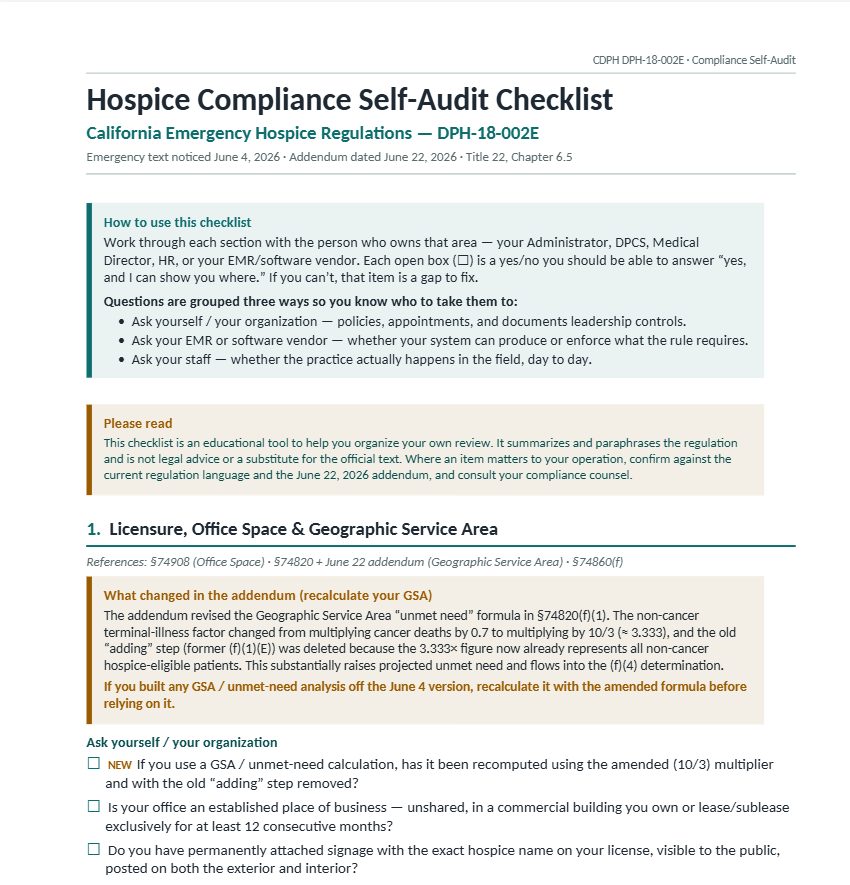
California’s emergency hospice regulations (Title 22 CCR §§ 74800–74908) have been live since June 22, 2026 — and there is no grandfather clause. An agency that was fine on June 21 can be citable today, not because the care changed, but because the rulebook did. The hard part isn’t understanding any one requirement. It’s knowing whether your agency, on your systems, with your people, actually meets all of them — and being able to prove it. So we built the tool we kept wishing existed: a 13-section, 100-plus-item Hospice Compliance Self-Audit Checklist, mapped question by question to the regulation. We walk through it in our free weekly CDPH webinar, and every attendee takes it back to their organization.
CDPH Emergency Regulation Changes — Live Q&A This Wednesday at 10:00 AM Pacific
Wednesday, October 14 · 40 minutes · Hosted by Miles Pickens, Hospice Engine
Bring your questions on CDPH’s emergency hospice licensing regulations (Title 22) — nurse ratios, management qualifications, CHOW, and the licensing moratorium. Zoom link sent by email when you register. The first 3 seats each Wednesday session are free.
Why a Checklist — and Why This One Is Built Differently
Since June, the most common question we hear from California operators isn’t about any single rule. It’s “where do I even start?” The emergency package runs from definitions to plan-of-correction procedure across more than two dozen adopted sections. Reading it is one thing; auditing your own agency against it is another.
The checklist turns the regulation into something you can actually run: every item is a yes/no question, and the standard for “yes” is deliberately strict — “yes, and I can show you where.” If you can answer yes but can’t point to the policy, the personnel file, the system report, or the chart entry that proves it, the item is a gap. That’s the same standard a CDPH surveyor applies: under these regulations, doing it right and being able to prove it are two different clocks.
The other thing we did differently: the questions are grouped by who can actually answer them, because a compliance review is not a one-person job.
- Ask yourself / your organization — the policies, written appointments, and documents leadership controls. Is the Administrator appointed in writing? Is the acuity committee actually constituted? Are personnel records producible within 24 hours?
- Ask your EMR or software vendor — whether your system can produce or enforce what the rule requires. Can it flag an admission outside your approved service area? Does the certification template force an individualized narrative instead of check boxes? Can it produce a full audit trail on demand?
- Ask your staff — whether the practice actually happens in the field. If a surveyor asked any front-line clinician to explain the significant-change notification steps or the 2-hour on-call standard, could they answer confidently?
That third column matters more than most operators expect. A policy binder answers the first set of questions. Only your people answer the last one — and a surveyor is allowed to ask them.
What the 13 Sections Cover
Each section cites the regulation it audits, so you can go from any checkbox straight to the source text:
- 1. Licensure, office space & geographic service area (§§ 74908, 74820, 74860(f)) — the unshared-office rule, signage, the 24/7 phone line, and whether every patient’s primary residence sits inside your approved service area.
- 2–4. Administrator, DPCS, and Medical Director (§§ 74876, 74852, 74856) — written appointments, the new degree and experience floors, designees, the 7-year disciplinary lookback, and the concurrent-employment caps with their 60-day vacancy and 10-business-day application clocks.
- 5. Management orientation & annual training (§ 74880) — the 24-hour first-time-manager requirement, 12 annual hours, and the exact documentation package you have to retain per person.
- 6. Nurse staffing & patient acuity (§ 74848) — the 12:1 cap, 24/7 licensed nursing, the six required elements of the acuity system, and the committee that has to review it.
- 7. Admission & certification of terminal illness (§ 74860) — the anti-boilerplate narrative rule, both dated signatures, and the attestation-above-the-signature requirement.
- 8–9. Assessments, plan of care & coordination (§§ 74864, 74868, 74872) — the 48-hour / 5-day clocks, the 15-day plan-of-care cycle, and the 24-hour significant-change notification.
- 10–11. Personnel records & medical records (§§ 74884, 74888–74896) — the pre-hire OIG exclusion check, the 24-hour production deadline, the new 10-year retention rule, and the correction and addendum workflow.
- 12. Electronic health records & EMR controls (§ 74900) — audit trails, unique logins with signed sole-authorship statements, 24-hour backups, and a written downtime procedure. This section is designed to be handed to your vendor whole.
- 13. Survey readiness & plan of correction (§§ 74904, 74808, 74828) — the 10-day Form State-2567 clock and whether every required policy is actually written, implemented, and maintained — not just drafted.
The Item Most Agencies Haven’t Caught: the June 22 Addendum
The checklist flags what changed after the original June 4 emergency text — and the biggest one is the first “NEW” box on page one. The June 22, 2026 addendum revised the geographic-service-area “unmet need” formula in § 74820(f)(1): the non-cancer factor changed from 0.7× to 10/3 (≈ 3.333×) and the old “adding” step was deleted. That substantially raises projected unmet need in every county. If you built any service-area or expansion analysis on the June 4 version, it’s roughly half the correct value — recalculate before you rely on it. We broke down the corrected formula, with a worked example, here.
The Four Fastest Wins
If you run the whole checklist, you’ll build a complete gap list. But for most agencies, four items close the most exposure the fastest:
- Recompute your GSA / unmet-need analysis with the addendum formula.
- Kill any templated or check-box certification narratives — the rule says individualized, and it’s a citation a surveyor can find in seconds.
- Confirm your EMR enforces the 15-day plan-of-care review and can produce a full audit trail on demand.
- Verify the concurrent-employment limits for your Administrator, DPCS, and Medical Director — there is no grace period to keep a shared arrangement.
The Webinar: Where We Walk Through All of It, Live
The checklist is comprehensive by design — which is exactly why we don’t just email it into the void. Every week, we host a live session that walks the regulation the way an operator needs to hear it: why these rules exist (the 2022 State Auditor findings they answer), then the requirements that change how you actually operate — the service-area math and the 2-hour rule, the 12:1 staffing cap, who may run your agency, the 120-day change-of-ownership flip, the certification trap where the state’s 12-month licensing definition and Medicare’s 6-month payment standard now both apply to you, and the shift that catches good agencies off guard: documentation is now a license condition, so the surveyor’s question is no longer “was the care right?” but “can the record prove it?”
We close with the federal picture — because CDPH compliance doesn’t clear the CMS moratorium, PPEO, or the Qlarant wave — and then take live Q&A. The sharpest questions we’ve gotten have turned into their own articles, like whether your hospice leader can also run a home health agency.
And every attendee leaves with the Self-Audit Checklist — yours to print, hand to your Administrator, DPCS, and Medical Director, and bring to your next EMR vendor call. It’s an educational tool, not legal advice; where an item matters to your operation, confirm it against the current regulation text and your counsel. But as a way to organize your review and force the right conversations, it does in an afternoon what most agencies haven’t gotten to in three weeks.
The Bottom Line
These regulations are enforced now, they reach every licensed hospice in California, and the agencies that come through cleanly will be the ones that found their own gaps before a surveyor did. The checklist exists so you can run that survey on yourself first — with the people who can actually answer each question. Register below for the next session, bring your hardest question to the Q&A, and take the checklist home.
CDPH Emergency Regulation Changes — Live Q&A This Wednesday at 10:00 AM Pacific
Wednesday, October 14 · 40 minutes · Hosted by Miles Pickens, Hospice Engine
Bring your questions on CDPH’s emergency hospice licensing regulations (Title 22) — nurse ratios, management qualifications, CHOW, and the licensing moratorium. Zoom link sent by email when you register. The first 3 seats each Wednesday session are free.
Already Found Gaps You Can’t Close Alone?
The checklist tells you where you stand. Hospice Engine helps you fix what it finds — certification workflows that force individualized narratives, timestamped addendums, audit trails a surveyor can pull in minutes, caseload and service-area analysis under the corrected formula, and PPEO-ready billing. We’ve walked hospices through state and federal oversight since 2012.
Talk to Our Compliance Team Related: The Full CDPH Rulebook, Section by Section