
Something significant happened in California hospice this month, and most operators have not felt it yet. On June 11, 2026, the California Department of Public Health (CDPH) filed emergency regulations that establish the first comprehensive licensing framework California hospice has ever had. The intended effective date was June 22; the rules take effect upon final sign-off from the Office of Administrative Law (OAL), and when that happens, they are live immediately. This is not a proposed rule with a comment period stretching into next year. It is happening now.
For 36 years — since the California Hospice Licensure Act of 1990 — the state has licensed hospices without a real operational rulebook behind that license. That vacuum is what these regulations close. Below is what they actually require, where the exposure is, and what to do this week.
CDPH Emergency Regulation Changes — Live Q&A This Wednesday at 10:00 AM Pacific
Wednesday, October 14 · 40 minutes · Hosted by Miles Pickens, Hospice Engine
Bring your questions on CDPH’s emergency hospice licensing regulations (Title 22) — nurse ratios, management qualifications, CHOW, and the licensing moratorium. Zoom link sent by email when you register. The first 3 seats each Wednesday session are free.
What Exactly Happened — and the Status Right Now
Here is the precise state of play, because the regulatory status matters:
- Filed June 11, 2026 as emergency regulations, codified at Title 22, California Code of Regulations, sections 74800–74908.
- A five-day public comment window ran June 11–16, 2026 — days, not the months a normal rulemaking gets.
- Intended effective date: June 22, 2026, contingent on final approval by the Office of Administrative Law. Once OAL approves an emergency regulation, it is effective immediately.
- They are “emergency” and therefore temporary — but CDPH has stated it intends to pursue a regular rulemaking to make the same requirements permanent. Treat them as the new baseline, not a passing measure.
The authority traces back through a decade of California trying to get its arms around hospice fraud: SB 664 (2021) imposed the new-license moratorium; AB 2673 (2022) directed CDPH to write emergency regulations; and AB 177 (2024) extended the deadline. The substantive trigger was the March 2022 California State Auditor report (2021-123), which found “widespread indicators of fraud and abuse” concentrated in Los Angeles County — including one administrator running 27 separate hospice agencies, multiple agencies sharing a single address or operating with no signage, and brand-new licenses being flipped for sale as “never billed.”
CDPH has explicitly declared a “factual emergency” in hospice oversight. The numbers behind that finding: per the Governor's office, California has revoked more than 280 hospice licenses in roughly the past two years, with approximately 300 more agencies under evaluation for revocation. This rulebook is the enforcement infrastructure being built on top of that wave.
What the Regulations Actually Require
This is where the competitor posts go vague. Here is the specific substance, section by section, so you can check yourself against it.
1. Staffing: a hard 12:1 nurse ratio and 24/7 coverage
Proposed section 74848 sets a 12:1 nurse-to-patient ratio — a licensed nurse (RN or LVN) may be assigned no more than 12 patients at any one time. This is a first-of-its-kind hard cap in hospice. On top of it, the rules require 24/7 licensed nursing availability and a patient-acuity system to set caseloads. If your scheduling cannot demonstrate that no nurse exceeded 12 patients on any given day, that is a documentation problem now, not just an operational one.
2. Management qualifications — and concurrent-employment caps
The regulations put real credential and experience floors under your leadership roles:
- Administrator: a baccalaureate or higher in a health-related field, plus 2+ years of supervisory or managerial experience in hospice, home health, a primary care clinic, or a health facility within the past 5 years.
- Director of Patient Care Services: an RN with a baccalaureate or higher plus 2+ years of hospice/home-health supervisory experience in the past 5 years, or 4+ years of such supervisory experience.
- Medical Director: a current California physician-and-surgeon license plus 2+ years of supervisory/managerial experience in hospice, home health, or palliative care in the past 5 years.
- Concurrent-employment limits: an Administrator or DPCS may run one hospice (two if rural); a Medical Director may cover one (three if rural). The 27-agencies-one-administrator pattern is now expressly prohibited.
- A disciplinary action against the relevant professional license within 7 years makes a person ineligible, and vacancies must be filled within 60 days.
3. Training hours, now mandated
- First-time managers: 24 hours of educational training or a certification program within 12 months of hire.
- All management: 20 hours of new-hire orientation within 60 days, then 12 hours of annual training covering policies, patient care, fraud prevention, controlled substances, and compliance.
4. Geographic service area and a 2-hour response standard
A licensed nurse must be able to reach a patient within a two-hour travel time for medical needs or safety concerns — which effectively bounds how large a service area you can claim. CDPH also layers in a county-level “unmet need” formula (built from cancer-death data against an assumed capacity of roughly 56 patients per licensed hospice) that governs where new service is justified.
5. Change of ownership: 120 days' advance notice, approval before closing
If you are contemplating a sale, this section reshapes your timeline:
- A transfer of 50% or more beneficial ownership is a full change of ownership (CHOW) requiring a 120-day advance application and CDPH approval before the deal closes.
- A 5–49% transfer triggers a streamlined version of the same 120-day advance process.
- Each approved CHOW resets a five-year clock, and management or governing-body changes must be reported within 10 business days.
6. Office and physical-presence requirements
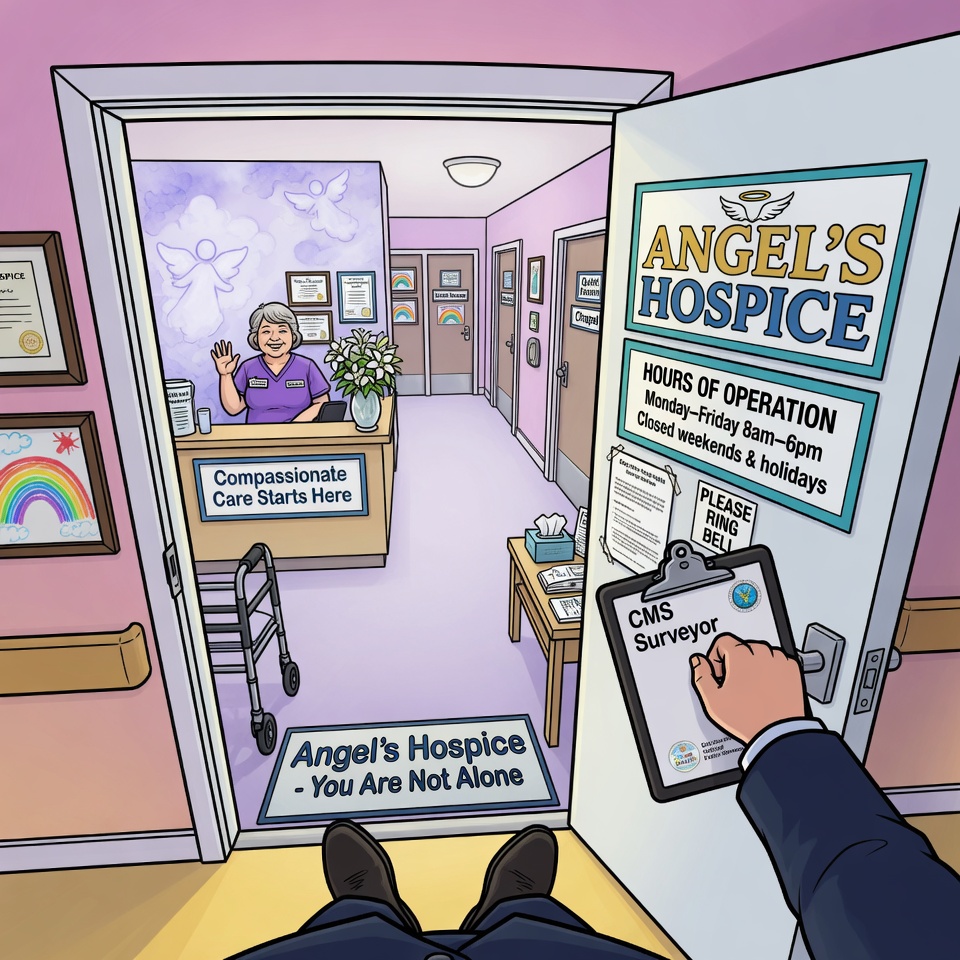
Aimed squarely at the “hospice mill” pattern: unshared commercial office space with exclusive possession, permanently attached interior and exterior signage, a 24/7 active business telephone, and secure storage for records, medications, and personnel files. Sharing a suite or operating without signage is now a citable deficiency.
7. Medical records and certification — codified, not customary
This is the one with the longest tail. Documentation standards are now license conditions. The clearest example: a terminal-illness certification must carry the medical director's (or designee's) and the attending physician's signatures, plus an individualized clinical narrative supporting the terminal prognosis — not a boilerplate, copy-forward statement. When a surveyor reviews a chart, the question is no longer just “was the care right?” It is “does the record prove it met the codified standard?”
The Moratorium Timeline — Read This Carefully If You Are Planning to Expand
California has barred CDPH from issuing any new hospice license since January 1, 2022. The statute (Health & Safety Code § 1751.70) keeps that bar in place “until January 1, 2027, or one year after the date emergency regulations are adopted pursuant to Section 1753.1.” Because those emergency regulations are being adopted now, in June 2026, the one-year-after-adoption clock runs into mid-2027.
The practical takeaway: do not plan on the new-license moratorium lifting before 2027, and given the “one year after adoption” language, plan conservatively for it to run toward the middle of that year. Confirm the controlling date with counsel before you bank on any new licensure. And keep three separate clocks straight — this state new-license moratorium is not the same as the federal CMS enrollment moratorium imposed in May 2026, nor the same as the CHOW timelines above.
State License vs. Federal Medicare: Two Separate Tracks Hitting the Same Operators
If your head is spinning, it is because California operators are now being squeezed from two directions at once, and they are different systems:
- The federal track — CMS, your Medicare Administrative Contractor, and UPIC Qlarant — controls your Medicare payments. That is the payment-suspension wave we have been covering, with its 15-day rebuttal clock and its own enforcement tools.
- The state track — CDPH — controls your license to operate at all in California. These emergency regulations are that track finally getting teeth.
You can be clean on one and exposed on the other. A hospice that survives a Qlarant payment suspension can still lose its CDPH license over staffing-ratio or documentation deficiencies — and vice versa. Each track has its own surveyors, its own standards, and its own clock.
Where the Real Exposure Is: Can Your System Prove It?
Here is the uncomfortable part. For most legitimate operators, the clinical team is already doing the right things — the right visits, the right oversight, the right care. That is not the question a surveyor asks. The question is whether your documentation system can produce the proof on demand, in a format that holds up under review.
Under these regulations, that means being able to show, quickly:
- That no licensed nurse exceeded 12 patients on any given day — from your actual schedule, not an after-the-fact reconstruction.
- That every terminal-illness certification carries the required signatures and an individualized narrative — with no copy-forward language a surveyor can flag.
- That management credentials, training hours, and the 60-day vacancy rule are tracked and current.
- That 24/7 nursing availability and your acuity determinations are recorded, not just asserted.
Agencies running on older, charting-only systems — the ones built as a digital filing cabinet rather than a compliance engine — are the ones most likely to have the care right and the proof missing. That gap is exactly what turns a good agency into a cited one.
What To Do This Week
- Pull your nurse schedules and check the 12:1 ratio. Find any day a licensed nurse was assigned more than 12 patients, and fix the staffing model now.
- Audit your terminal-illness certifications. Confirm both required signatures and a genuine, individualized prognosis narrative on each — and kill any boilerplate.
- Verify your management roster against the new floors. Credentials, experience, the 7-year disciplinary lookback, concurrent-employment caps, and any vacancy past 60 days.
- Document training hours. Make sure the 24-hour, 20-hour, and 12-hour requirements are scheduled and logged.
- Map your service area against the 2-hour response rule, and freeze any CHOW or expansion planning until you have walked the 120-day and moratorium timelines with counsel.
- Stress-test your EMR. Ask one question of your current system: if a CDPH surveyor walked in tomorrow, could you produce each of the proofs above in minutes — or would you be assembling them by hand?
California has operated in a hospice oversight vacuum since 1990. That vacuum closes the moment OAL signs off. The agencies that come through this well will be the ones whose systems were built to prove compliance, not just to store charts.
CDPH Emergency Regulation Changes — Live Q&A This Wednesday at 10:00 AM Pacific
Wednesday, October 14 · 40 minutes · Hosted by Miles Pickens, Hospice Engine
Bring your questions on CDPH’s emergency hospice licensing regulations (Title 22) — nurse ratios, management qualifications, CHOW, and the licensing moratorium. Zoom link sent by email when you register. The first 3 seats each Wednesday session are free.
Is Your EMR Built for the New CDPH Standard — or Just for Charting?
Hospice Engine was built as a compliance engine for hospice, not a filing cabinet. Real-time caseload and 12:1 ratio visibility, certification and signature tracking that flags boilerplate before a surveyor does, management-credential and training logs, and audit-ready records you can produce on demand. Our team also walks California operators through exactly how these emergency regulations map to their day-to-day — and we work alongside whatever EMR you run today.
Talk to Our Compliance Team The Federal Side: Qlarant Suspensions