
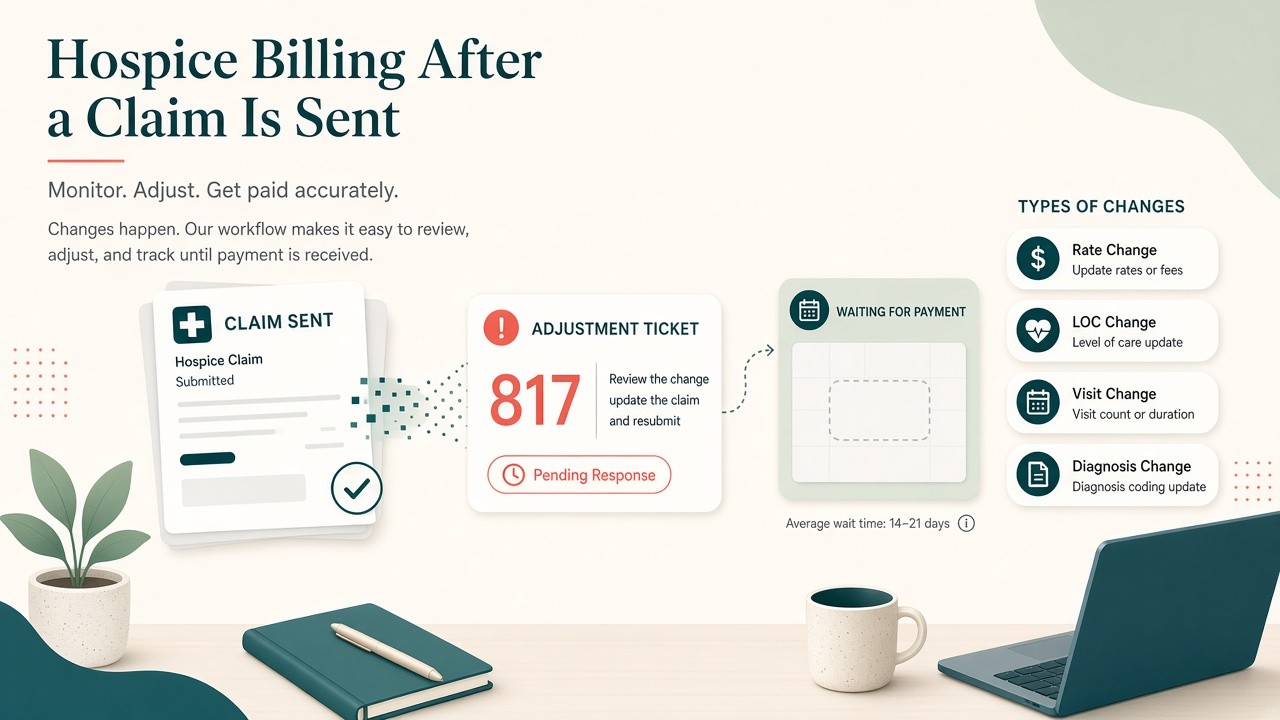
Most hospice billing problems do not start at claim creation. They start in the days after the claim has already left the building.
A nurse updates a visit. Clinical revises a diagnosis. Level of care changes mid-episode. Discharge is entered late. The rate on the notice of election no longer matches what actually happened. None of that is unusual. What is unusual is how often the biller does not see it until the claim is already sitting in a payer queue, waiting for an ICN that may take days or weeks to come back.
CDPH Emergency Regulation Changes — Live Q&A This Wednesday at 10:00 AM Pacific
Wednesday, September 16 · 40 minutes · Hosted by Miles Pickens, Hospice Engine
Bring your questions on CDPH’s emergency hospice licensing regulations (Title 22) — nurse ratios, management qualifications, CHOW, and the licensing moratorium. Zoom link sent by email when you register. The first 3 seats each Wednesday session are free.
That gap is where 817-style adjustments get missed.
The claim is not the end of the episode
Hospice billing assumes the claim reflects a finished picture. In practice, the clinical record keeps moving after submission.
Common post-send changes include:
- Rate or LOC updates that land after the claim was batched
- Visit corrections (missed documentation, late entries, discipline swaps)
- Diagnosis or principal diagnosis revisions
- Discharge date changes or late discharge posting
- Election or benefit-period corrections that affect how the claim should have been built
Each of those can require an adjustment claim. If the biller only looks at what was sent, and then waits for remittance or ICN before reconsidering the episode, the window to catch the change quietly closes.
Why waiting for the ICN creates a blind spot
The ICN is useful. It is also late information.
While the claim is in flight, the EMR and billing system may already know that something changed. The nurse charted. The clinician signed. The scheduler fixed a visit. The discharge nurse closed the episode. Those events are real. They just are not sitting on the remittance advice yet.
If the workflow is "send claim, wait for ICN, then decide whether to adjust," billers are forced into a reactive loop:
- Something clinical changes after submission
- Nobody flags it as a billing event
- The original claim processes as if nothing changed
- An adjustment is needed later, often under time pressure
- Or worse, the change never becomes an adjustment at all
That is not a training failure. It is a visibility failure. The system that knows about the clinical change is not the same place the biller is watching while the claim is pending.
What "unsent" should mean for billers
Billers do not need another alert for every chart edit. They need a clear view of claims that have left the house but are no longer accurate relative to the current clinical record.
An unsent adjustment queue is one practical answer. Conceptually, it is a worklist of episodes where:
- A claim was already submitted
- A later clinical or administrative change would affect that claim
- An adjustment has not yet been prepared or sent
That queue turns post-send drift into work instead of surprise. The biller can review rates, LOC, visits, diagnoses, and discharge timing against what was billed, then decide what needs an 817-style correction before the remittance cycle forces the issue.
The point is not to auto-generate every possible adjustment. The point is to stop pretending the claim is frozen simply because it has a submit timestamp.
What operators should ask of their billing/EMR stack
If you run hospice revenue cycle, ask a few concrete questions of your current tools:
- After a claim is sent, can clinical changes on that episode surface as billing work, not just chart history?
- Can billers see pending or in-flight claims alongside later LOC, visit, dx, and discharge updates?
- Is there a place to park "needs adjustment" work before the ICN comes back?
- Can someone tell, in one screen, whether the current record still matches what was billed?
A stack that answers those well reduces missed adjustments without adding another spreadsheet.
Hospice Engine is built around that kind of billing and EMR continuity: clinical events and claim status in the same operational picture, so post-send changes do not disappear into a waiting period. Soft sell only. The workflow still belongs to your billers. The software should make the blind spot smaller.
A practical habit while you evaluate tools
Even before you change systems, tighten the handoff between clinical and billing for the first 48 to 72 hours after a claim batch:
- Treat late visit documentation as a billing event, not only a charting catch-up
- Review LOC and discharge changes against the last submitted claim for that benefit period
- Keep a short list of "claim sent, record changed" episodes until they are either confirmed clean or queued for adjustment
That habit will not replace a proper unsent-adjustment view. It will show you how often your agency already has the problem.
See Hospice Engine
Billing and EMR in one operational picture — so post-send changes do not disappear while you wait for an ICN.
Visit Hospice EngineBottom line
Hospice billers miss 817 adjustments after the claim is sent because the claim leaves before the episode stops changing, and because waiting for an ICN is not the same as watching the record. Give billers a way to see unsent adjustment work while the claim is still in flight, and the blind spot shrinks.
See how Hospice Engine handles billing and EMR in one place: https://www.hospice.us.com