
CMS is actively cracking down on hospices whose live discharge rate runs over 40% between January 1, 2025 and March 31, 2026. That single statistic is the hook behind the April 2026 wave of payment suspensions that has already frozen Medicare payments for hundreds of hospices — with letters seen so far at rates as low as 55% and as high as 100%. If you use Hospice Engine, you can pull your own number in under a minute — and you should, today.
For the full regulatory backstory, see our recent coverage:
- CMS Just Paused Medicare Payments for 447 California Hospices — What the Qlarant Letter Means
- The Live Discharge Rate Trap: Why CMS Is Targeting California Hospices
- Got a Qlarant “Notice of Suspension”? The 15-Business-Day Rebuttal Playbook
- Medicare Payments Frozen, Payroll Friday: A Cash-Flow Survival Playbook
This post is the short, operational version for our Hospice Engine clients: here is exactly where to click to see your own rate, and what to do with the number once you have it.
CDPH Emergency Regulation Changes — Live Q&A This Wednesday at 10:00 AM Pacific
Wednesday, October 14 · 40 minutes · Hosted by Miles Pickens, Hospice Engine
Bring your questions on CDPH’s emergency hospice licensing regulations (Title 22) — nurse ratios, management qualifications, CHOW, and the licensing moratorium. Zoom link sent by email when you register. The first 3 seats each Wednesday session are free.
Why Over 40% — and Why This Date Range
CMS has publicly stated that the national average live discharge rate is roughly 18%. The AI-assisted review being run by the federal anti-fraud task force is concentrating on hospices running roughly two to six times that average — in practice, letters seen so far have been issued to hospices with rates anywhere from the mid-50% range up to 100% — over the January 1, 2025 through March 31, 2026 window.
CMS has not published an exact threshold, but the working assumption based on letters issued so far: if your rate for that window is over 40%, you should assume you could be included in a future audit sweep. During that audit CMS may pause your Medicare payments and request documentation on recent live-discharged claims. If your rate is well under 40%, you are outside the current enforcement band — not immune forever, but not in the flag zone today.
Step 1: Open Management Statistics
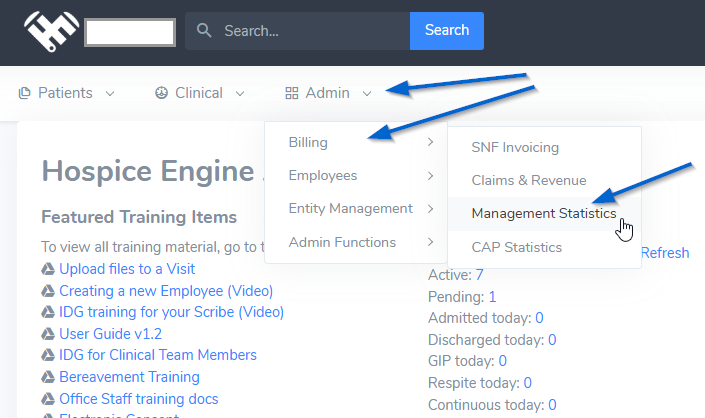
From your Hospice Engine home screen, go to Admin → Billing → Management Statistics.
Step 2: Run the CMS Window
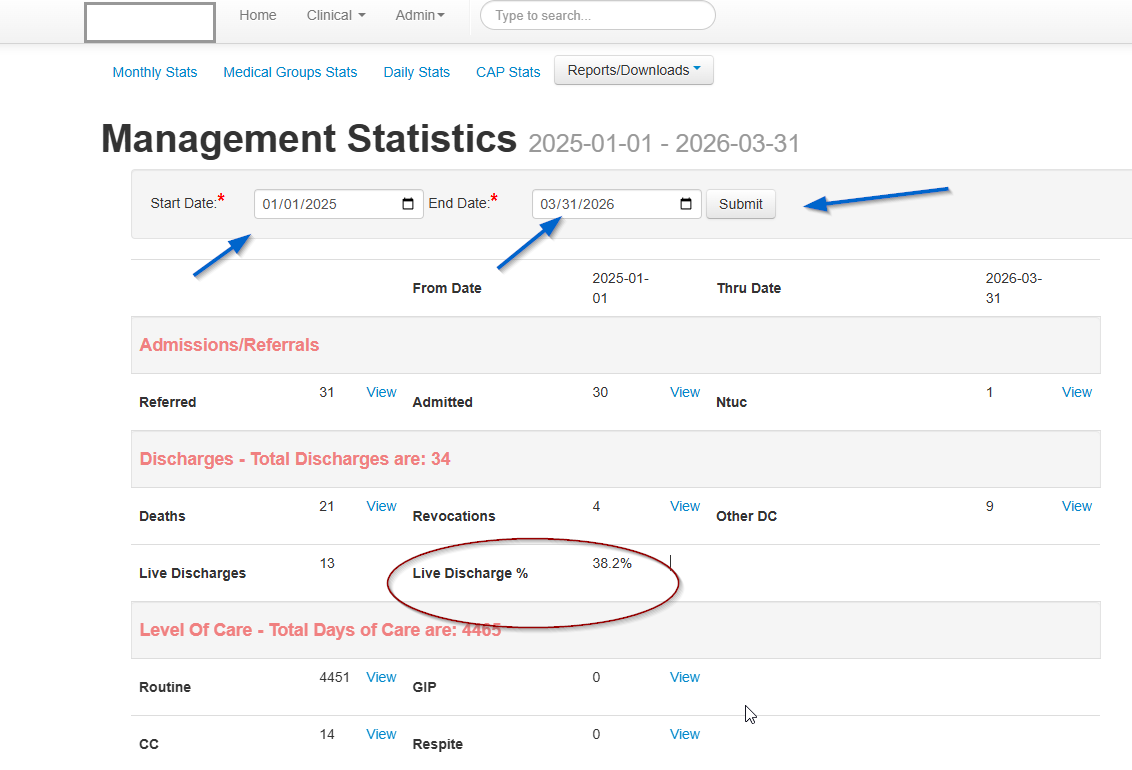
On the Management Statistics page, set the date range to match the exact window CMS is using:
- Start Date: 01/01/2025
- End Date: 03/31/2026
Click Submit. Scroll to the Discharges section and look for the Live Discharge % value.
Step 3: Read the Number
| Your Live Discharge % | What It Means Right Now |
|---|---|
| Under 30% | Within the national distribution. Low statistical risk. Keep documentation tight and re-check quarterly. |
| 30–40% | Elevated but not yet in the current sweep zone. Document the clinical reasons and watch your trajectory. |
| Over 40% | Inside the audit window the AI-assisted review is actively surfacing. Assume you could be flagged and start preparing now. |
Remember, CMS is comparing your rate against a national average of roughly 18%. The audit window appears to begin at roughly two times that average (~40%) and runs all the way up — letters seen so far cite rates from the mid-50% range to 100%.
If You’re Over 40%: What to Do Today
- Do not mass-discharge or change your numbers. Sudden changes in discharge patterns are themselves an algorithmic flag. The rebuttal you may have to file is built from charts that already exist.
- Pull the list of live-discharged patients in the window. In Hospice Engine you can click into the Live Discharges and Revocations views from this same Management Statistics page to get the patient-level breakdown.
- Audit certifications and recertifications. For each live discharge, confirm that the physician narrative shows specific clinical findings supporting the six-month prognosis at each benefit period — not boilerplate.
- Categorize every live discharge. Revocation, no-longer-terminal, transfer, discharge for cause, moved out of service area. The mix matters. Reviewers expect revocations and transfers; they scrutinize no-longer-terminal discharges hardest.
- Get help before a letter arrives. A proactive audit is dramatically cheaper than a 15-business-day rebuttal under a payment freeze.
Our Live Discharge Rate Trap post walks through the deeper benchmarking, what legitimate reasons for an elevated rate look like, and how to build a self-assessment memo.
If You’re Under 40%: Don’t Relax Too Much
The 40%+ band is the current focus, not a permanent safe harbor. The same AI methodology can easily be re-tuned to surface hospices at 30% or 20% in a later pass, especially in states running under the Provisional Period of Enhanced Oversight (PPEO). Our recommendation for every Hospice Engine client:
- Re-pull Management Statistics for this window once a quarter.
- Also pull trailing 12 months to see your direction of travel.
- Keep physician narratives specific and clinical on every cert and recert — that is the single biggest lever if you ever do get flagged.
Not Sure What Your Number Means?
If you pulled your Management Statistics and your Live Discharge % is anywhere near the 40% threshold — or you just want a second set of eyes on your certifications before a CMS review gets there first — we can help. Our compliance team runs live discharge rate audits for Hospice Engine clients and non-clients alike.
Schedule a ConsultationThe Bottom Line
An elevated live discharge rate — anything over 40% for the Jan 2025–Mar 2026 window — is CMS’s current enforcement trigger, and it has already frozen hundreds of hospices’ payments in the last few weeks. As a Hospice Engine client, you are two clicks away from knowing whether you are in that band. Run the report this week. If you are clear, document that you checked. If you are not, start the cleanup while you still have the runway to do it calmly.